
If you are reading this, you have probably already made the decision that matters: some or all of your embedded work is going outside. A new product line needs a circuit board and firmware depth your team does not have. An older board is built on components that are going out of production. Or a safety-critical requirement (railway, automotive, medical) demands certified process discipline you have not built internally yet.
What you need now is not a definition of embedded design. You need a defensible shortlist you can take into a budget conversation this week.
Here it is, with one honest caveat up front: LIFO Technologies publishes this article, and LIFO appears on this list. We explain exactly where, why, and how we evaluated everyone, including ourselves, in the methodology section below. If a list will not tell you that much, treat its rankings accordingly.
Comparison Table
| Vendor | HQ / Delivery Regions | Specialization Cluster | Certifications & Proof | Best Fit For |
| LIFO Technologies | Chennai, India / Global | Full-stack (hardware + firmware + validation + edge AI) | Named institutional deployments (BPCL, Indian Railways Kavach programme); ISO 9001 and 27001 certification in progress | Full product builds, legacy modernization, hardware-software co-design under one roof |
| Softeq | Houston, USA / Global | Full-stack | Broad IoT and consumer electronics portfolio | US-headquartered end-to-end IoT builds |
| Promwad | EU (Lithuania) / Global | Full-stack | Consumer, automotive, and industrial electronics portfolio | European full-cycle design with manufacturing handoff |
| Apriorit | Ukraine, USA / Global | Firmware & software | ISO 27001, ISO 9001, TISAX | Security-sensitive firmware, drivers, low-level software |
| Witekio | Lyon, France / Global | Firmware & software | Long-standing embedded software specialization, OS-level work | Embedded Linux, Android, and connectivity software layers |
| MicroSys Electronics | Germany | Hardware & PCB | Verified NXP Gold Partner | NXP-based board design and system-on-module work |
| Integra Sources | Kazakhstan / Global | Hardware & PCB | 250+ completed projects since 2014; full design-documentation handover | Board design from concept to fabrication-ready files |
| SYSGO | Germany (Thales Group) | Safety-critical | PikeOS deployed in high-assurance aviation environments | Certified RTOS and avionics-grade software platforms |
| Sii Poland | Poland / EU | Safety-critical & automotive | Vector certification for AUTOSAR automotive projects | AUTOSAR and automotive-grade embedded programmes |
| Lemberg Solutions | Ukraine / EU | Safety-critical (medical) | ISO 13485:2016 certified | Medical device firmware under regulatory scrutiny |
Vendor details compiled from public sources in August 2026. Verify current certifications and team details directly during procurement.
How We Picked This List (Methodology)
Most articles ranking embedded design companies are written by embedded design companies. That is not automatically disqualifying, but it becomes a problem when the ranking is presented as neutral research and the publisher quietly sits at number one. At least one widely-read list in this category does exactly that, with no disclosure anywhere on the page.
So here is our full disclosure: this article is published by LIFO Technologies, and LIFO Technologies appears in the full-stack cluster below. We did not rank the list 1 through 10, because a flat ranking across vendors who do fundamentally different things is meaningless. A firmware-only specialist and a certified avionics RTOS vendor are not competing for the same statement of work.
Instead, every vendor was evaluated on four criteria:
- Specialization depth. What the firm demonstrably does at production grade, not what its services page claims.
- Certifications and named standards. ISO 13485, ISO 27001, TISAX, AUTOSAR and Vector credentials, and equivalent third-party validation, with preference for certifications that are named, dated, and checkable.
- Verifiable track record. Named clients, deployed systems, or public programme references rather than anonymized "Fortune 500" claims.
- Global delivery capability. The ability to serve clients beyond the home market, since most buyers reading this are not in the vendor's home city.
Not every vendor publishes the same depth of proof. Where a firm's public evidence is thinner, we say so in its entry rather than padding it, and we recommend you request specifics directly. That standard applies to everyone on this list, including us.
Then we sorted the results through what we call the 4-Lens Filter: is this vendor a hardware-only shop, a firmware-only shop, a full-stack partner, or a safety-critical specialist? This is the distinction that actually determines fit, and it is the one every flat top-10 list flattens away.
10 Best Embedded Product Design Partners
Full-Stack Partners (Hardware + Firmware + Validation)
Choose this cluster when you need one accountable partner across schematic, PCB layout, firmware, testing, and manufacturing handoff, and you do not want to arbitrate between a board house and a software shop when integration breaks.
1. LIFO Technologies (Chennai, India)
Best fit: full product builds, legacy modernization, and buyers who want hardware, firmware, and validation accountable under one roof.
LIFO is an embedded product design partner that builds embedded products from chip to cloud, and it is the only firm on this list that ships its own products at institutional scale in addition to running client programmes.
That distinction matters: a vendor that lives with its own hardware in the field for years learns lessons about reliability, serviceability, and lifecycle cost that pure project shops never absorb.
Core capabilities:
- Hardware design and development, circuit board (PCB) layout, and new product introduction (taking a design into manufacturing)
- Firmware engineering across STM32, ARM, AVR, and PIC chip families, including real-time operating systems
- Functional testing and validation as a dedicated discipline with its own team and infrastructure
- Power systems and power electronics design
- Legacy board modernization: re-engineering boards built on discontinued components using current chips, while preserving how the product behaves in the field
- Edge AI and vision AI integration for products that need intelligence on the device itself
Delivery approach:
- Hardware, firmware, and validation engineers work as one co-located team in Chennai through a stage-gated process with clear checkpoints from design review to validated release, so integration issues surface at the bench, not at the customer site.
- One accountable owner runs the programme from first schematic through validated release, with global delivery on the same model.
Finished products and IP:
LIFO owns and operates its own product lines, not just client deliverables.
- VENDCYL, its LPG cylinder vending machine, was designed end to end and is deployed in the field with BPCL, with national media coverage.
- Trax, its vision AI platform, runs in production on edge hardware across fuel retail forecourts.
- CATalytics, its cylinder-tracking software, closes the loop from device to cloud.
- On the services side, LIFO delivered an event logger for Indian Railways' Kavach train collision avoidance programme, a safety-relevant institutional deployment.
| Read our customer success stories here |
What differentiates LIFO:
- Product ownership plus services discipline in one organization;
- hardware, firmware, cloud, and AI under a single roof rather than stitched across subcontractors;
- legacy modernization treated as a first-class service line;
- India-headquartered delivery in a category where the entire published vendor landscape looks only at Eastern Europe and the US.
2. Softeq (Houston, USA)
Softeq is a one-stop development firm that takes a connected product from idea to launch: it designs the electronics, writes the firmware, builds the companion mobile apps, and connects everything to the cloud. Headquartered in Houston with engineering teams in the US and Europe, it serves clients globally, with most of its portfolio in IoT and consumer electronics.
Its positioning is breadth: one partner covering hardware, software, and cloud so you never have to coordinate several vendors yourself. Its public proof leans on portfolio breadth rather than named certifications, so ask directly for references in your specific domain, and budget for a US-headquartered rate card.
Key services:
- Hardware design and prototyping
- Firmware for microcontrollers and embedded Linux
- Wireless connectivity (Bluetooth, Wi-Fi, cellular)
- Cloud integration and companion apps
Core expertise:
End-to-end connected product development, with the team scale to staff large programmes.
3. Promwad (EU)
Promwad is a European electronics design house that handles the full journey from circuit design to the factory floor. Headquartered in Lithuania with engineering teams across Europe, it serves clients in Europe and North America across industrial, automotive, and consumer products.
Its positioning is design-to-manufacturing continuity: the same engagement covers electronics design, embedded software, enclosure design, and the handover to production, so nothing gets lost between the design house and the factory. As with Softeq, the public material is capability-broad rather than proof-deep, so request named references in your vertical.
Key services:
- Board design
- Embedded software development
- Enclosure design,
- Preparing designs for cost-effective manufacturing,
- Managing the transfer to production partners.
Core expertise:
Full-cycle product development with production handoff managed inside one engagement.
Firmware & Software Specialists
Choose this cluster when your hardware is settled (in-house or through a separate partner) and the risk lives in software: device drivers, real-time operating system work, connectivity, and security.
4. Apriorit (Ukraine / USA)
Apriorit specializes in the deepest layers of software, the code most developers never touch: device drivers, operating system kernels, virtualization, and security-sensitive firmware. Its engineering base is in Ukraine with a US business presence, and it serves clients primarily across North America and Europe, many of them in cybersecurity and data-sensitive industries.
Its positioning is security-first low-level engineering, and it backs that with an unusually strong compliance posture for a firmware specialist: ISO 27001 (information security), ISO 9001 (quality management), and TISAX (the automotive industry's data security standard). If your product handles regulated or sensitive data, this is one of the few firmware shops that can prove its own house is in order.
Key services:
- Driver and kernel development,
- Virtualization,
- Reverse engineering,
- Security engineering for embedded and system software.
Core expertise:
Security-sensitive low-level software delivered under certified quality and information-security systems.
5. Witekio (Lyon, France)
Witekio focuses on the software layer that sits between the chip and the application: the code that makes an operating system like Linux or Android actually run on your specific hardware. Headquartered in Lyon with offices across Europe, North America, and Asia, it serves device makers globally in both consumer and industrial markets.
Its positioning is depth in a deliberately narrow slice: it does not design boards or build end products, it makes the operating system layer work properly and keeps it maintained for years. A good match when hardware is already in flight and you need this layer done right the first time.
Key services:
- Board support packages (the low-level software that brings a new board to life)
- Embedded Linux and Android platform work
- Connectivity software
- Long-term OS maintenance and updates
Core expertise:
The operating system and middleware layer between silicon and application.
Hardware & PCB Specialists
Choose this cluster when your firmware team is solid and the gap is board-level: circuit design, board layout, and getting a design ready for reliable manufacturing.
6. MicroSys Electronics (Germany)
MicroSys is a German hardware house that designs embedded computing boards, particularly system-on-modules: ready-made compute boards that drop into a larger product and save you from designing the hardest part of the electronics yourself. Based in Germany, it serves mainly European industrial clients, with reach beyond Europe through the NXP semiconductor ecosystem.
Its positioning is deep alignment with one chipmaker: as a verified NXP Gold Partner, it knows NXP silicon at a level generalist design houses cannot match, which shortens risk considerably if your architecture is already committed to NXP.
Key services:
- System-on-module design
- Custom carrier boards built around those modules
- Board bring-up
- Supporting low-level software
Core expertise: NXP-based embedded computing hardware, weighted toward industrial and safety-relevant applications.
7. Integra Sources (Kazakhstan)
Integra Sources is a compact electronic design firm, founded in 2014 with a team of around 50, that takes a circuit board from idea to a fabrication-ready design: component selection, schematics, board layout, prototyping, and testing on its own in-house equipment. Its development center sits in Central Asia, close to Chinese manufacturing partners, and it serves clients worldwide, largely startups and device makers in North America and Europe, with more than 250 completed projects.
Its positioning is design without lock-in: it does not manufacture, but hands over the complete documentation package your chosen factory needs, fabrication files, bill of materials, and testing instructions, and can help you place the production order. Suits buyers who want a board designed, proven, and fully documented, with manufacturing and software decisions staying in their own hands.
Key services:
- PCB design and layout (rigid, flexible, multilayer, and high-speed boards)
- FPGA design
- Component selection
- Prototyping and prototype testing
- Preparing designs for manufacturing and certification.
Core expertise:
Board-level electronic design taken from concept to fabrication-ready documentation, with firmware support available from the same team.
Safety-Critical & Regulated-Industry Specialists
Choose this cluster when a certification standard, not a spec sheet, defines success: the formal safety standards that govern aviation, automotive, medical, and railway products. Here, the certified process is the product.
8. SYSGO (Germany)
SYSGO is different from everyone else on this list, deliberately: it sells a certified operating system product rather than engineering services. Its PikeOS operating system is built to keep safety-critical and non-critical software strictly separated on the same chip, and it runs in high-assurance aviation environments. Based in Germany and part of the Thales Group, it serves aviation, railway, and automotive programmes worldwide.
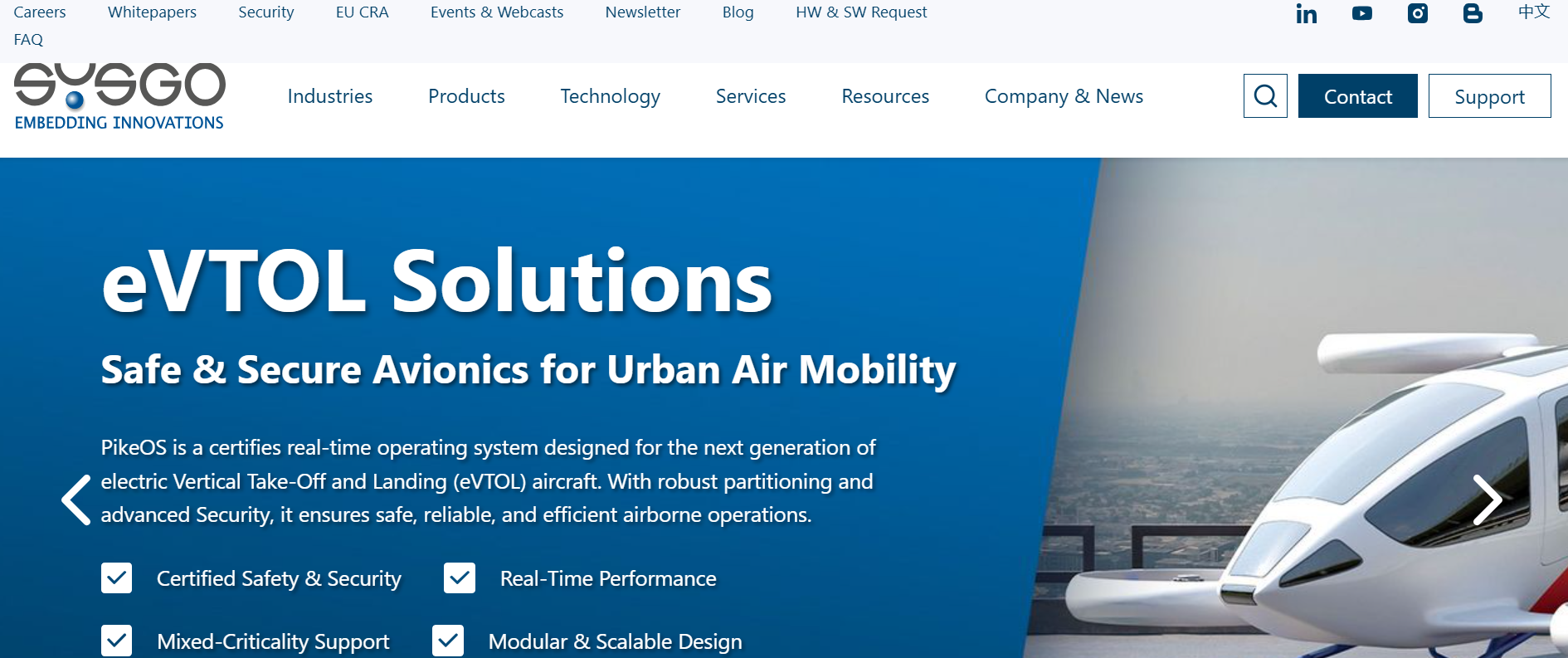
Its positioning is carrying the safety case for you at the operating system level: when a regulator needs proof the software foundation cannot fail dangerously, SYSGO's certification evidence is the product you are buying. Relevant when your product needs a certified foundation, not a project team.
Key services:
- PikeOS operating system
- ELinOS industrial-grade Linux
- Certification support for safety-critical platforms
Core expertise: certified operating systems for programmes where the OS itself must carry the safety case.
9. Sii Poland (Poland)
Sii is one of Poland's largest engineering firms, delivering automotive embedded software at programme scale. Based in Poland, it serves European clients directly and global automotive programmes through its scale, with thousands of engineers available across disciplines.

Its positioning is fluent in the automotive industry's standard toolchain: it holds Vector certification for AUTOSAR projects (AUTOSAR being the standardized software architecture used across the car industry). Relevant when your programme lives inside that ecosystem and needs a partner already fluent in it.
Key services
- AUTOSAR development and integration
- Automotive embedded software
- Testing and validation at programme scale.
Core expertise: automotive-grade embedded delivery inside the Vector/AUTOSAR ecosystem, with the ability to scale a team quickly.
10. Lemberg Solutions (Ukraine)
Lemberg is a Ukrainian engineering firm building connected devices from firmware to cloud, with a specific credential most competitors lack: a documented ISO 13485:2016 certification, the quality-management standard required for medical device work, confirmed through a surveillance audit in May 2023. It serves clients across Europe and North America.
Its positioning is regulated-product discipline at services-firm rates: the certified quality system means it can work on products where an auditor reviews the engineering process itself. A credible option for connected medical products where the regulatory pathway drives the engineering plan.
Key services:
- Firmware on Linux and real-time operating systems
- Custom low-level board software
- Wireless connectivity (Bluetooth, LoRaWAN, Wi-Fi)
- Device-to-cloud integration
- Medical device engineering
Core expertise: connected device development under a certified medical-device quality management system.
How to Choose Between Them
Three questions collapse this list to two or three names fast:
1. Where does your risk actually live? If a bad board respin is the expensive failure mode, weight the hardware and full-stack clusters. If your board is proven and the schedule risk is software, go firmware-first. If an auditor signs off on your product before a customer does, start and end in the safety-critical cluster.
2. Do you need single-point accountability or a specialist bolt-on? Full-stack partners cost more per engagement but eliminate the most expensive failure mode in outsourced embedded work: the integration gap between a hardware vendor and a software vendor, each of whom insists the bug is on the other side.
3. What does the vendor's proof look like under pressure? Anonymized logos and Clutch stars are weak evidence for embedded work, because embedded failures surface six to twelve months after signing, long after the reviews were written. Named deployments, named certifications with dates, and named institutional clients are the proof that survives due diligence. Ask every vendor on your shortlist for exactly that, including us.
If your answers point to full-stack accountability or legacy modernization backed by named institutional proof, that is the profile LIFO was built for. Talk to Sales and bring your hardest requirement to the first call.
Conclusion
The embedded design vendor market does not lack lists. It lacks honest ones. Most rankings in this category are flat top-10s written by vendors who place themselves first without saying so, treat a firmware shop and an avionics RTOS company as comparable line items, and draw exclusively from the same Eastern Europe and US pool.
This shortlist takes the opposite approach: disclosed methodology, disclosed self-inclusion, vendors clustered by the specialization axis you actually decide on, and a credible India-headquartered option with named proof (BPCL, Indian Railways Kavach).
If your requirement maps to the full-stack or legacy modernization lens, talk to LIFO's sales team. Bring your schematic, your end-of-life notice, or your compliance requirement, and we will tell you honestly, in the spirit of this article, whether we are the right fit or whether another cluster on this list serves you better.
FAQ
How do I choose an embedded systems design partner?
Start with the 4-Lens Filter: decide whether you need hardware-only, firmware-only, full-stack, or safety-critical capability, because vendors in different lenses are not substitutes for each other. Then evaluate the two or three vendors in your lens on named certifications, verifiable deployments, and how they handle validation and testing. A vendor who cannot describe their test discipline in detail is showing you where your rework budget will go.
How much does embedded product design cost?
More variably than software development, because hardware is in the loop. A focused firmware engagement can run in the low tens of thousands of dollars, while a full product design with custom PCB, enclosure, firmware, and certification testing typically runs into the low-to-mid six figures across a multi-month cycle. Region shifts rates significantly across US, European, and Asian delivery bases, but rate card is the weakest single selection criterion in this category: the expensive outcomes are respins and rework, not hourly billing. Get fixed-scope quotes for the first milestone and compare on validation discipline, not blended rate.
Should I outsource embedded software development or hire in-house?
Hire in-house for capabilities that are core to your product's differentiation and will be exercised continuously. Outsource when the need is project-shaped (a board design, a platform bring-up, a legacy migration), when the specialization is expensive to hold permanently (safety certification expertise, RF, power electronics), or when time-to-hire would blow the schedule. Many mature teams do both: a small internal core owning architecture, with a design partner providing surge capacity and specialist depth.
What certifications should an embedded design partner have?
It depends entirely on your domain. ISO 9001 signals baseline quality management; ISO 27001 matters if the vendor touches sensitive data or IP; ISO 13485 is essential for medical devices; ISO 26262 and AUTOSAR credentials for automotive; DO-178C experience for aviation. Beware of vendors listing every standard on their website: ask which certifications are current, who audited them, and when.
What questions should I ask an embedded design vendor before signing?
Six that separate real capability from good pitching: Who owns the IP, including schematics, layout files, and source, at each payment milestone? Can you show a named, deployed product comparable to mine? What is your process when a board fails EMC or environmental testing? How do you handle component end-of-life during and after the engagement? What does your firmware test discipline look like in practice, and can I see artifacts? And who, by name, will be the senior engineer on my project? Any vendor who hesitates on the IP question or the named-engineer question has answered a different question for you.
Why is legacy board modernization worth a specialist partner?
Because it is a constraint-driven redesign, not a fresh design: the new board must match the old board's field behavior, interfaces, and often its enclosure, while replacing silicon that no longer exists. Firms that only do greenfield work routinely underestimate the reverse-engineering, regression testing, and side-by-side validation this requires. It is one of the few embedded services where prior experience with the same problem shape predicts outcome almost directly.