
Key Takeaways:
- Embedded software testing is not the same as general software QA. It requires physical equipment — hardware-in-the-loop (HIL) rigs, environmental chambers, EMC pre-compliance setups, and accredited labs for wireless/protocol certification/
- Our central selection criterion is whether a vendor actually owns its test infrastructure (rigs, chambers, labs) or just subcontracts and passes on the cost. A vendor that owns its equipment can iterate daily; one that books time elsewhere can't.
- We cover seven aread of testing: Functional/firmware testing, integration testing, HIL testing, environmental stress screening, EMC pre-compliance, protocol/wireless certification, and safety-critical validation (ISO 26262, IEC 61508, IEC 62304).
- The article tells readers to start from their own trigger (certification deadline, field failure/safety sign-off, capacity shortage, or scale) rather than from the list, and to ask every vendor three questions: What equipment do you own, and can we see it? Which certifications can we verify independently? Can you show a named project with a similar device?
If you are reading this, you probably have a date in mind. A certification submission, a safety sign-off, a production ramp. Your internal team is good, but they do not own a test bench that can simulate a vehicle's electrical system, or an accredited lab that can sign off a Bluetooth product, and you need someone who does.
You have probably also noticed that a lot of "top 10 embedded testing companies" pages read like they were written by a machine and sponsored by the companies on them. Some of them were. This article is our attempt to do better: a transparent method, a filter that actually separates vendors, and a plain statement that our own company is on the list.
What "Embedded Software Testing Services" Actually Covers
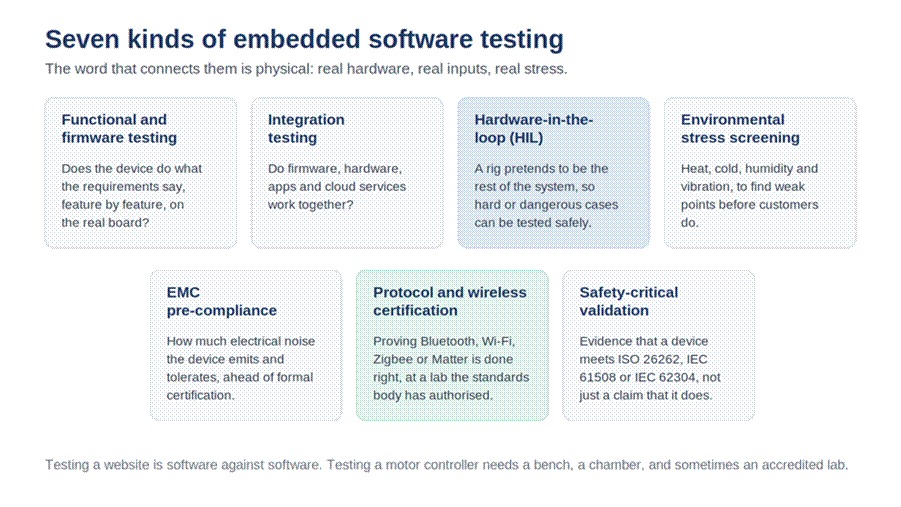
Embedded software testing services are specialist services that test the firmware and software inside a physical device, on the actual hardware, under the conditions the device will face in the field. They cover:
• Functional and firmware testing checks that the device does what the requirements say, feature by feature, on real hardware.
• Integration testing checks that firmware modules, hardware, and any connected apps or cloud services work together.
• Hardware-in-the-loop (HIL) testing connects the device to a rig that pretends to be the rest of the system (a car, a factory line, a power grid) so you can test scenarios that are hard, slow, or dangerous to create for real.
• Environmental stress screening runs the device through heat, cold, humidity, and vibration to find weak points before customers do.
• EMC pre-compliance checks how much electrical noise the device emits and how well it tolerates noise from others, ahead of formal certification.
• Protocol and wireless certification proves the device correctly implements a standard such as Bluetooth, Wi-Fi, Zigbee, or Matter, usually at a lab authorised by the standards body.
• Safety-critical validation demonstrates, with evidence, that a device meets a functional safety standard such as ISO 26262 for vehicles or IEC 61508 for industrial systems.
The word that matters in that definition is "physical".
Testing a website means running software against software. Testing a motor controller means running firmware on a real board, feeding it real or simulated sensor inputs, watching what it does when the supply voltage dips, and proving it recovers. That requires equipment, and the equipment is what separates vendors.
How We Picked This List (Methodology)
We used four criteria, and we applied the first one hardest.
1. Genuine test-infrastructure ownership. Does the vendor own the rig, the chamber, or the lab, or do they subcontract it and pass on the cost? We call this the Owns the Rig filter. A vendor that owns its HIL benches can iterate with you daily. A vendor that books time at someone else's lab cannot.
2. Accreditations and quality evidence. For wireless and protocol work, is the vendor recognised by the relevant standards body? For safety and functional work, can they show test records and a delivery record against the standard, not just a mention of it on a page?
3. Verifiable proof. Named clients, published case studies, or accreditations you can check on the standards body's own website.
4. Transparency. We are including LIFO Technologies in this list. We think it belongs here, and we say why in its entry, but you should weigh that entry knowing who wrote it.
One more thing. Several "best of" lists ranking for this search are generated automatically, score vendors with made-up numbers, and sell placement to the vendors they rank. We have not named them, but you will recognise them: no named clients, no accreditations you can check, and a link inviting vendors to "apply for a listing". Treat them as advertising.
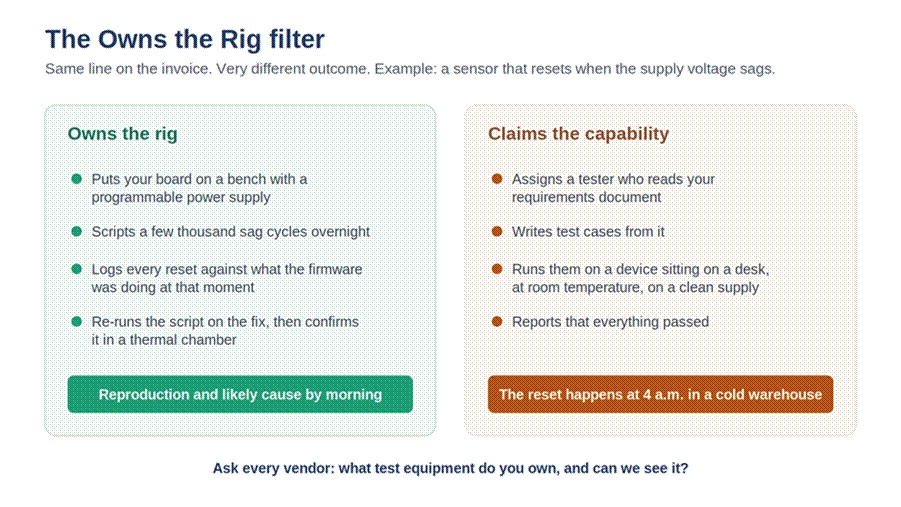
The Owns the Rig filter. Same word on the invoice, very different outcome.
What "owns the rig" looks like for software testing services?
A quick example makes the filter concrete. Suppose your product is a battery-powered industrial sensor that occasionally resets in the field, and you suspect it happens when the supply voltage sags under load.
A vendor that owns its test infrastructure will put your board on a bench with a programmable power supply, script a few thousand voltage-sag cycles overnight, log every reset, and correlate it with what the firmware was doing at the time. By the next morning you have a reproduction and a likely cause. Then they will run the same script on the fixed firmware, and put the board in a thermal chamber to confirm the fix holds at the temperature extremes on your datasheet.
A vendor that lists "testing" as a capability will assign a tester who reads your requirements, writes test cases, runs them on a device sitting on a desk, and reports that everything passed. The reset does not happen on a desk. It happens at 4 a.m. in a cold warehouse when the radio transmits during a sensor read.
Same word on the invoice. Very different outcome. That is why we sorted the list the way we did.
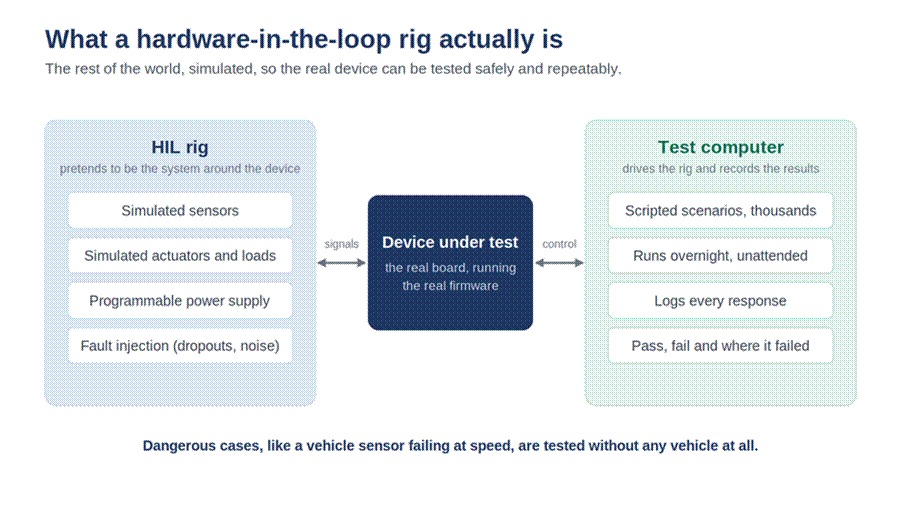
What a hardware-in-the-loop rig actually is: the rest of the world, simulated, so the device can be tested safely and repeatably.
Comparison Table
| Vendor | Test infrastructure owned | Accreditations and quality evidence | Specialisation | Best fit for |
| LIFO Technologies | HIL setups, environmental stress screening, EMC pre-compliance | No accreditation; rigs and test records open to inspection | Functional, HIL, safety-critical validation on devices it also designs | Full-device testing; safety-critical embedded products |
| Embitel Technologies | HIL validation for automotive ECUs | ISO 26262 process experience (verify current) | Automotive embedded | Automotive and mobility validation |
| CETECOM Advanced | Accredited wireless labs (Germany, Korea) | Bluetooth SIG BQTF | Wireless qualification and regulatory | Bluetooth qualification, multi-market approval |
| Granite River Labs | Connectivity standards labs (US, Taiwan, Singapore) | CSA Authorized Test Provider (Matter) | Standards compliance | Matter and interface certification |
| needCode | Protocol test automation, interoperability rigs | ISO 9001, ISO/IEC 27001 | Bluetooth, Zigbee, Thread firmware and testing | Wireless protocol testing and automation |
| SaM Solutions | Embedded QA teams and automation | Ask for current list | Broad embedded QA | Flexible long-term QA engagements |
| Softeq | Device, app, and cloud QA | Ask for current list | Full-stack product QA | Products spanning device, app and cloud |
| Integra Sources | Firmware and wireless test capability | Ask for current list | Practical embedded testing | Smaller teams, focused scopes |
| eInfochips | Proprietary wireless test automation framework | Ask for current list | Enterprise test automation | Large device portfolios |
| Expleo | Global validation facilities | Ask for current list | Automotive and aerospace validation | Large regulated programmes |
The Shortlist: 10 Embedded Software Testing Partners
Rather than a flat ranking, we have grouped vendors by what they are built for, because the right choice depends entirely on what you need tested.
Full-Stack Functional and Safety-Critical Testing
These vendors test the whole device, hardware and firmware together, and can take on safety-critical validation.
1. LIFO Technologies (Serving India, USA, UAE, Australia)
LIFO is an embedded engineering company that designs hardware and writes firmware, and runs a Functional Testing and Validation line for its own projects and for clients. The infrastructure it owns includes HIL test setups, environmental stress screening, EMC pre-compliance, and automotive-grade validation protocols.
The proof point that matters most for safety-critical buyers is the event logger LIFO built for Kavach, Indian Railways' automatic train protection system. The device records and time-stamps safety-critical events in tamper-evident memory, and had to be validated to railway-grade reliability requirements, including environmental and power-interruption testing. LIFO also runs the functional testing for the LPG cylinder vending machines it built for BPCL, where sensor-gated safety logic has to be proven across every dispensing scenario before a unit ships.
LIFO is not an accredited lab and does not do formal certification submissions; that work belongs to the accredited-lab group below. What it offers is the physical test infrastructure and the test records to prove it, which is the filter this article applies to everyone.
Strengths: owned HIL, environmental and EMC pre-compliance infrastructure; testers who also write firmware; safety-critical delivery record on Kavach.
Trade-off: not an accredited certification lab; formal submissions go to the specialists in the next group.
Best fit for: hardware and IoT companies that need functional, HIL, and environmental testing on a real device, especially where the device is safety-critical or the testing partner also needs to understand the firmware deeply. Disclosure: this is our company.
If that describes your situation, talk to our team about your test plan. Talk to sales
2. Embitel Technologies
Embitel is an automotive-focused embedded services firm that has spent most of its life building and testing electronic control units (ECUs) for vehicle makers and their suppliers. Testing is not a separate department bolted onto the side; it grew out of the ECU development work, which means the test engineers understand what the firmware under test is trying to do.
That background shows in the tooling. Embitel runs hardware-in-the-loop validation for automotive controllers, works to ISO 26262 process expectations, and is used to producing the traceability documents that a vehicle programme audit will ask for. It is a narrower shop than the enterprise providers, and it is at its best when the product is a vehicle component rather than a general IoT device.
Strengths: deep automotive ECU experience, HIL validation, familiarity with ISO 26262 documentation.
Trade-off: automotive is the centre of gravity; products outside mobility get a less tailored fit.
Best fit for: automotive and mobility products that need standards-driven validation from a team that also builds ECUs.
Firmware and Protocol / Wireless Certification Specialists
These vendors own accredited labs. If your deadline is a certification submission, this is the group to start with.
3. CETECOM Advanced (Germany and South Korea)
CETECOM Advanced is a testing and certification laboratory, and that distinction matters. It does not write your firmware or extend your QA team. It is the place your product goes when a standards body or a regulator needs an official result. The company holds Bluetooth Qualification Test Facility (BQTF) authorisation from the Bluetooth SIG, and runs accredited labs in Germany and South Korea that cover both protocol qualification and the regulatory approvals a wireless product needs to be sold in different markets.
For a buyer, the value is that one lab visit can cover several submissions. A product that needs Bluetooth qualification plus CE, FCC and Korean approvals can get them from one place, with one set of engineers who know how the submissions interact. The cost is that a certification lab is set up for formal submissions, not for iterating on your firmware every day; you arrive ready or you pay for a second visit.
Strengths: standards-body authorisation you can verify, multi-market regulatory testing under one roof, formal reports regulators accept.
Trade-off: not a development partner; the product should be pre-tested before it arrives.
Best fit for: wireless products with a certification deadline that need Bluetooth qualification and regulatory approval across several markets.
4. Granite River Labs (San Jose, USA, with labs in the US, Taiwan and Singapore)
Granite River Labs (GRL) built its reputation on connectivity standards. It is one of the labs the industry uses for USB, Thunderbolt and display interface compliance, and it has extended that into the smart home: GRL is a CSA Authorized Test Provider for Matter certification, which means its results are accepted by the Connectivity Standards Alliance for the Matter logo.
That standards-body relationship is the reason to choose GRL. If your product's launch depends on carrying a certification mark, pre-testing anywhere else only gets you part of the way; the official submission has to go through an authorised lab. GRL's footprint across the US, Taiwan and Singapore also suits companies whose manufacturing is in Asia and whose product team is in North America.
Strengths: CSA authorisation for Matter, long record in interface compliance, labs close to both design teams and factories.
Trade-off: focused on standards compliance rather than functional or environmental testing of your firmware.
Best fit for: smart home and connected devices that need Matter or interface certification from an authorised lab.
5. needCode (Kraków, Poland)
needCode is a wireless and embedded engineering firm that treats testing as part of building the stack rather than an afterthought. The company holds ISO 9001 and ISO/IEC 27001 certification, has been an official Qorvo partner for more than five years, and contributed to the Silvair Bluetooth Mesh stack, described as the first commercially certified Bluetooth Mesh implementation. Its engineers know Bluetooth, Zigbee and Thread from the inside, which is what makes its protocol-level test automation credible.
needCode is also unusually open about how it works. Its own comparison of wireless test automation companies, from which some of the vendor facts in this article are drawn, sets out a clear filter for separating a wireless firmware specialist from a general QA vendor, and it places itself last on its own list. Read its self-description with the usual care, but the accreditations and partnerships are verifiable.
Strengths: protocol-stack depth, verifiable quality and security certification, interoperability test automation.
Trade-off: a specialist in wireless; products whose testing burden is mainly mechanical or environmental will need another partner for that part.
Best fit for: Bluetooth, Zigbee and Thread products that need protocol-level testing and automation from a team that has shipped the stacks.
General Embedded QA and Test Automation Vendors
These vendors extend your QA team with embedded-aware testers and automation, without the specialist lab infrastructure of the group above.
6. SaM Solutions (Germany, with delivery centres in Europe)
SaM Solutions is a software services company with a defined embedded testing service line, which is more than many general outsourcers can say. Its published scope covers firmware, network, performance, interoperability, integration, security, failover and recovery, and compliance testing, and it offers those through three cooperation models: an internal team on the client's side, a dedicated team, or team extension where SaM engineers join yours.
That flexibility is the reason to consider SaM. For a company whose QA team is competent but stretched, the ability to add embedded-aware testers for six months and then scale down is worth more than a lab full of equipment it does not need. What SaM does not offer is the accredited-lab or safety-standard depth of the specialists above, so it sits in the capacity group rather than the certification group.
Strengths: broad embedded QA coverage, flexible engagement models, European delivery.
Trade-off: no standards-body accreditation; depth on safety-critical validation should be checked project by project.
Best fit for: companies that want a flexible embedded QA team on a longer engagement, without buying a lab.
7. Softeq (Houston, USA)
Softeq is a full-stack development company that builds hardware, firmware, mobile apps and cloud services, and offers QA across all of them. The testing offer follows the development offer: if your product is a device plus an app plus a backend, Softeq can test the way the three behave together, which is where a lot of connected-product bugs actually live.
The trade-off is the same as for any full-stack firm. Testing is one service among many rather than the company's core identity, so the specialist equipment and the accreditations that a certification lab or a safety-critical validator brings are not the point here. Softeq is a strong choice when the scope is wide and the goal is one vendor covering the whole product experience.
Strengths: device, app and cloud QA from one vendor, US-based account management with European engineering.
Trade-off: a generalist; specialist rigs and lab accreditations are not its offer.
Best fit for: products where the testing scope spans the device, the mobile app and the cloud service, and one vendor should cover all three.
8. Integra Sources (Riga, Latvia)
Integra Sources is an embedded engineering firm with a documented wireless testing capability and a 4.9 rating on Clutch, which is a useful signal for a smaller vendor because Clutch reviews are verified with the client. The company builds firmware and hardware as well as testing them, so it belongs to the same broad family as LIFO and needCode: engineers who test what they understand, at a smaller scale.
Integra suits smaller product teams that need practical firmware and wireless testing help without an enterprise contract, and that value direct access to the engineers doing the work. As with any boutique, ask about availability and about named projects in your product category before committing.
Strengths: engineer-led testing, strong client reviews, accessible for smaller scopes.
Trade-off: boutique capacity; no accreditations for formal certification submissions.
Best fit for: smaller teams that need focused firmware and wireless testing support.
Enterprise-Scale Embedded Testing Providers
These vendors run multi-year, multi-product testing programmes for large organisations.
9. eInfochips (Ahmedabad, India; an Arrow Electronics company)
eInfochips is a large product engineering company, part of Arrow Electronics since 2018, and it approaches testing the way a large organisation should: with frameworks. It operates its own Wireless Connectivity Test Automation Framework, which it reports cuts testing effort by roughly 40 percent compared with manual execution, plus a separate Bluetooth qualification framework that prepares products for formal SIG submission.
For an enterprise with dozens of device variants, that automation is the point. Regression testing every firmware release across a portfolio is not a job for a small team with a bench, and eInfochips has the headcount and the tooling to run it as a programme. The overhead that comes with a large provider is the trade-off; a single product with a single deadline will find the engagement heavier than it needs.
Strengths: proprietary test automation frameworks, enterprise scale, Arrow's supply-chain relationships.
Trade-off: engagement model built for programmes, not for one product with one deadline.
Best fit for: enterprises with large device portfolios that need test automation at scale.
10. Expleo (France, global)
Expleo is an engineering and quality services group headquartered in Paris with a strong presence in automotive and aerospace validation. It runs testing programmes for large regulated organisations across many countries, and it brings the process discipline those sectors demand: formal test plans, traceability to requirements, and the documentation that a safety audit expects to see.
That makes Expleo the choice when the question is capacity across borders and standards rather than depth on a single device. A vehicle programme validating components from suppliers in three countries, or an aerospace supplier that needs testing capacity it cannot hire quickly, is the kind of client Expleo is built for. A start-up with one connected device is not.
Strengths: global validation capacity, automotive and aerospace process maturity, multi-standard experience.
Trade-off: enterprise scale and cost; over-sized for single-product scopes.
Best fit for: large regulated programmes that need testing capacity across multiple countries and standards.
How to Choose Between Them
Start from your trigger, not from the list.
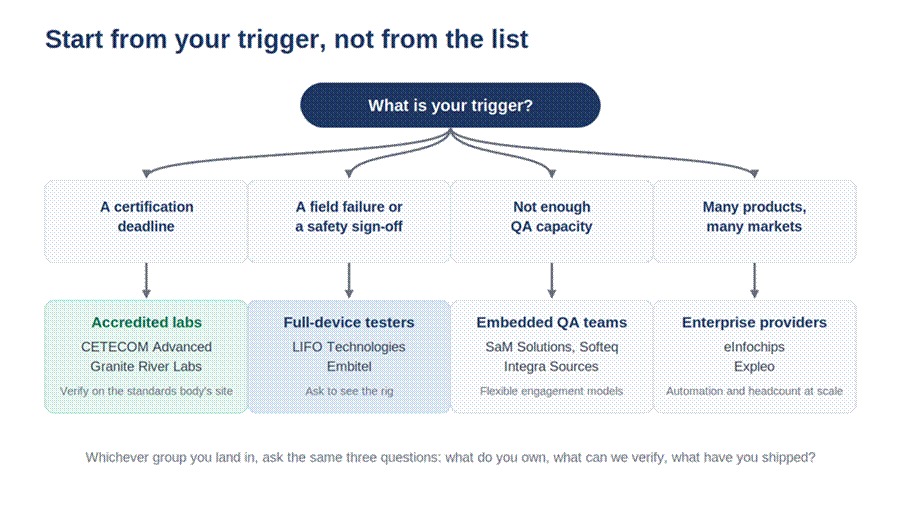
Start from your trigger, and the vendor group chooses itself.
Your trigger is a certification deadline. Go straight to the accredited-lab group. Check the accreditation on the standards body's own site (the Bluetooth SIG and the Connectivity Standards Alliance both publish lists) rather than trusting the vendor's page.
Your trigger is a field failure or a safety sign-off. You need someone who can put the real device on a rig, reproduce the failure, and prove the fix under stress. That is the full-stack group. Ask to see the rig.
Your trigger is capacity. Your QA team is competent but stretched, and you need more hands who understand firmware. The general embedded QA group is built for that.
Your trigger is scale. You have many products, many markets, and a multi-year roadmap. The enterprise group has the automation and the headcount.
Whichever group you land in, ask every candidate the same three questions on the first call: What test equipment do you own, and can we see it? Which certifications can we verify independently? Can you show us a named project with a similar device? A vendor that hesitates on all three is listing testing as a checkbox.
If you have answered those questions for your own project and want to compare notes with a team that owns its rigs, we are happy to talk. Talk to sales
Conclusion
Embedded software testing is not a commodity, and the rankings that treat it like one are not worth your time.
The question that cuts through the noise is simple: does this vendor own the rig, or do they just claim the capability?
We have tried to answer that honestly for ten vendors, including our own. If your project needs functional, HIL, environmental, or safety-critical validation on a real device, and you want a partner that also understands the firmware it is testing, talk to LIFO's team. Talk to sales
FAQ
How do I choose an embedded software testing partner?
Match the partner to your trigger: accredited labs for certification, full-stack device testers for functional and safety-critical work, QA extension firms for capacity, enterprise providers for scale. Then verify what they own and what they can prove.
What is the difference between embedded software testing and general QA testing?
General QA tests software against software. Embedded testing runs firmware on real hardware, feeds it real or simulated physical inputs, and tests behaviour under electrical and environmental stress. It needs equipment, not just testers.
What is hardware-in-the-loop (HIL) testing?
HIL testing connects a real device to a rig that simulates the system it will live in, such as a vehicle's sensors and actuators. It lets you test thousands of scenarios, including dangerous ones, repeatably and safely, before the device ever meets the real system.
Do I need an accredited lab for wireless or protocol certification testing?
For formal certification, yes. Standards bodies such as the Bluetooth SIG and the Connectivity Standards Alliance only accept results from labs they have authorised. Pre-testing can be done anywhere; the official submission cannot.
How much does embedded software testing cost?
It varies widely with scope. Functional testing on a simple device might be a few weeks of a small team's time. Full HIL, environmental, and safety validation for a regulated product can run to months and includes equipment time. Ask vendors for a scoped estimate against your requirements rather than a day rate.
What certifications should an embedded testing vendor have?
It depends on your product. For wireless: authorisation from the relevant standards body. For quality systems: ISO 9001, and ISO/IEC 27001 if they handle sensitive data. For safety-critical work: a documented delivery record against ISO 26262, IEC 61508, or IEC 62304, not just a mention of the standard.
What is the difference between pre-compliance testing and formal certification?
Pre-compliance testing is done early, on your own or a vendor's equipment, to find problems while they are cheap to fix. Formal certification is the official test at an authorised lab whose results the standards body or regulator accepts. Doing the first well usually means passing the second at the first attempt.
Can one vendor handle both functional testing and certification?
Sometimes, but usually not at the same depth. Accredited labs are set up for formal submissions, not for iterating on your firmware every day. Full-device testers are set up for the reverse. Many teams use one of each, with the functional partner preparing the product so the lab visit is short.