
Key Takeaways:
- Turnkey product development services take a product from concept to a manufacturable design and into production under one accountable partner.
- The term is used loosely, so the most important thing to check is which disciplines a provider actually does in-house and which it subcontracts.
- This article gives you a short vetting framework, explains which certifications matter for which product categories and what to ask for when a provider has none, compares six providers, and discloses upfront that LIFO Technologies is one of them.
You have already decided to work with an outside partner to build your product. That is the easy decision. The hard one is who, and by now you have probably opened a dozen vendor sites that all say the same thing: concept to manufacturing, single accountable partner, end-to-end. You have also probably noticed that most "top turnkey providers" round-ups are written by one of the providers, who happens to rank first.
This article is written by a provider too. The difference is that we say so, we put a vetting framework before the list so you can interrogate everyone on it (including us), and we try to explain what "turnkey" should actually mean before anyone gets a spot.
What "Turnkey" Actually Means in Product Development
Turnkey product development is a service model in which one partner takes responsibility for the whole journey from product concept through design, engineering, prototyping and testing to a manufacturable product, and often through production itself. The client receives a finished, working product rather than managing separate design, engineering and manufacturing vendors.
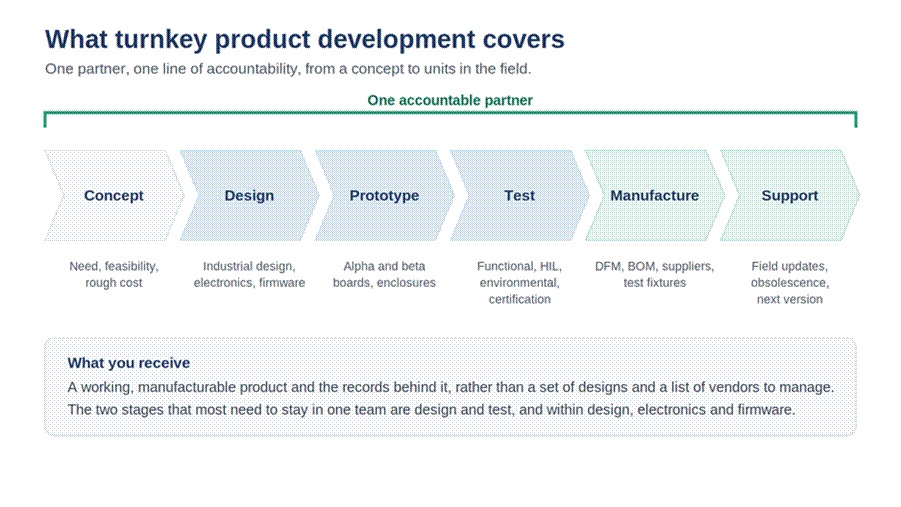
One partner, one line of accountability, from concept to units in the field.
Three things get confused with it.
Turnkey manufacturing is fabrication only. You bring a finished design; the manufacturer builds it. It is a good service, but if your product is not designed yet, it is not what you need.
A design agency covers industrial design and perhaps mechanical engineering, and hands you drawings. The electronics, firmware, and manufacturing are somebody else's problem.
A broker or marketplace model presents as one partner but coordinates subcontractors behind the scenes. You get one invoice and one project manager, but the design, the electronics and the manufacturing are done by companies you never meet. This model can work, but you should know that is what you are buying.
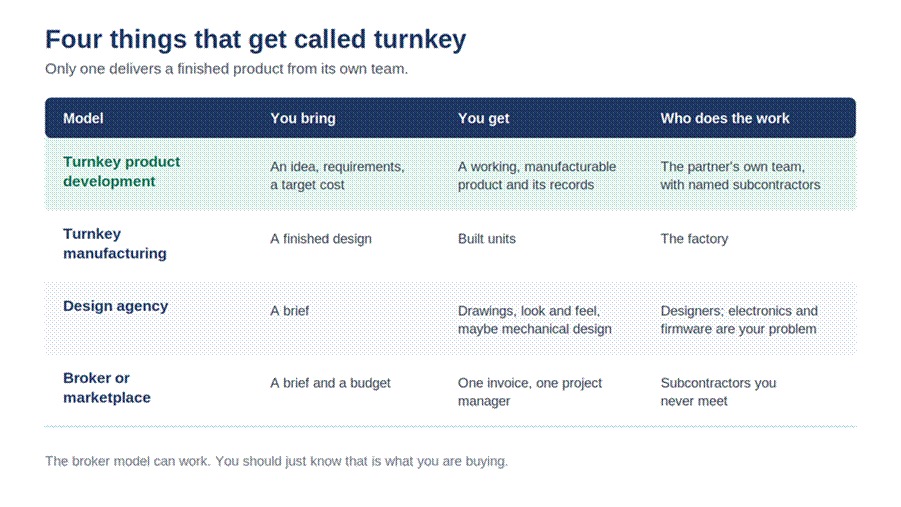
Four things that get called turnkey. Only one of them delivers a finished product from its own team.
Real turnkey product development means the partner has the core disciplines your product needs in-house, and is transparent about which ones it does not.
Next turnkey product development services: A Glance
| Provider | Core services | HQ | Certifications and quality evidence | Best for |
| LIFO Technologies | Hardware, firmware, testing, AI and vision, cloud; manufacturing via partners | Chennai, India | No ISO yet; design reviews and test records on request | Embedded products needing one engineering owner |
| eInfochips | Hardware to cloud product engineering | Ahmedabad, India | Verify on site | Enterprise multi-year programmes |
| Mistral Solutions | Embedded hardware and firmware design | Bengaluru, India | Verify on site | Defence, aerospace, complex boards |
| Softeq | Hardware, firmware, apps, cloud | Houston, USA | Verify on site | Connected products with strong app needs |
| StudioRed | Industrial design, mechanical, prototyping | Silicon Valley, USA | Verify on site | Design-led physical products |
| Cyient | Electronics design plus manufacturing | Hyderabad, India | Verify on site | Regulated programmes wanting design and production together |
How We Created This List
We shortlisted providers that publicly offer end-to-end product development for physical or embedded products, then looked at three things: which disciplines they own in-house, what quality evidence they can show (a verifiable certification, or design and test records where there is none), and whether they show named projects rather than just capability lists.
We included LIFO Technologies because we build embedded products end to end and this is a category we compete in. We have written our own entry to the same format as everyone else's and put it first only because it is ours; read it as a vendor's description of itself, and apply the framework below to it.
Questions to Ask Before You Sign: The In-House Test
This is the part of the article that is useful whichever provider you choose. Three questions.
Question 1: Which disciplines are in-house, and which are subcontracted?
Make a list of what your product needs. For most embedded or connected products it looks like this:
• Industrial and mechanical design (the shape, the enclosure, the feel)
• Electronics design (schematics and circuit board layout)
• Firmware and embedded software
• Application and cloud software (if the product connects to anything)
• Testing and validation (functional, environmental, compliance)
• Manufacturing and supply chain
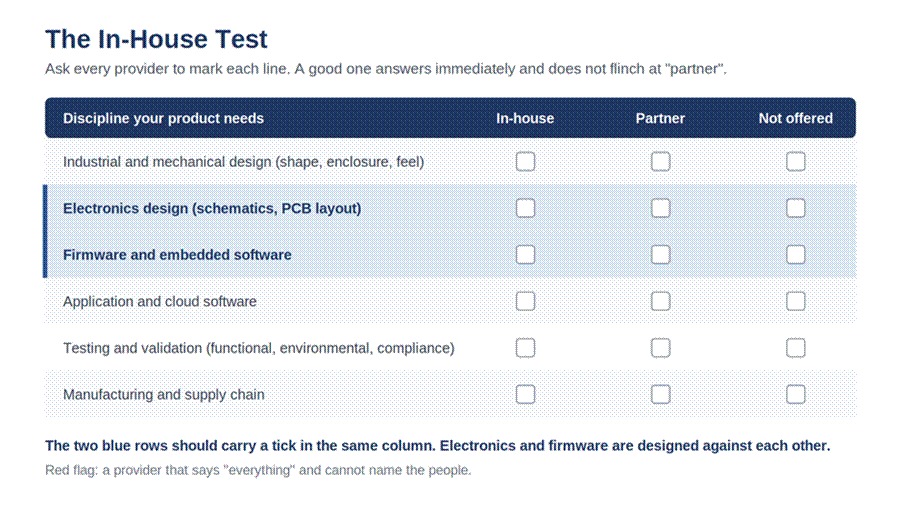
Hand this to every provider on your shortlist and ask them to fill it in.
Then ask each provider to mark every line as in-house, partner, or not offered. A good provider answers immediately and does not flinch at "partner". The red flag is a provider that says "everything" and cannot name the people.
The disciplines that matter most to keep together are electronics and firmware. They are designed against each other. Splitting them across vendors is the most common cause of integration delays in embedded products.
Question 2: What quality evidence does my product category actually need?
Provider sites list certifications the way restaurants list awards. Some of them matter a great deal for your product, some are irrelevant to it, and a provider without any may still be able to show you everything a certificate would have told you. Here is how to read them.
| If you are building | Look for | Why |
| Any commercial electronic product | ISO 9001, or documented process evidence | A working quality process matters more than the badge; a provider without ISO 9001 should be able to walk you through its design reviews and test records |
| A medical device | ISO 13485, plus IEC 62304 experience for software | Regulators expect the design process itself to be controlled |
| Automotive components | IATF 16949, plus ISO 26262 experience for safety functions | Automotive customers audit their suppliers' processes |
| Aerospace or defence | AS9100 | Aerospace quality system; without it, primes will not engage |
| A connected consumer or industrial device | Evidence of prior FCC, CE and BIS approvals | Market access certifications; a provider that has been through them designs for them |
| Anything handling sensitive data | ISO/IEC 27001 | Information security; relevant if the provider hosts or processes your data |
A certificate is a shortcut for checking a process. For regulated categories it is often mandatory, and there is no substitute: without ISO 13485 a medical device partner cannot realistically carry your product to a regulator. For unregulated products, a missing certificate is not disqualifying on its own, but it does mean you should ask to see the process directly: design reviews, change control, test reports, and prior FCC, CE or BIS approvals on shipped products.
If a provider holds a certification your category does not need, that is fine. If it lacks the one your category does need, ask how they intend to get your product through that regulator.
Question 3: How do you price, and what happens when scope changes?
Turnkey providers use three main models. Fixed fee gives you cost certainty and puts the risk of overruns on the provider, which is why fixed-fee quotes come with a detailed scope and change-request process. Time and materials gives you flexibility and puts the risk on you. Staff augmentation is really a hiring model: you get engineers, you manage them.
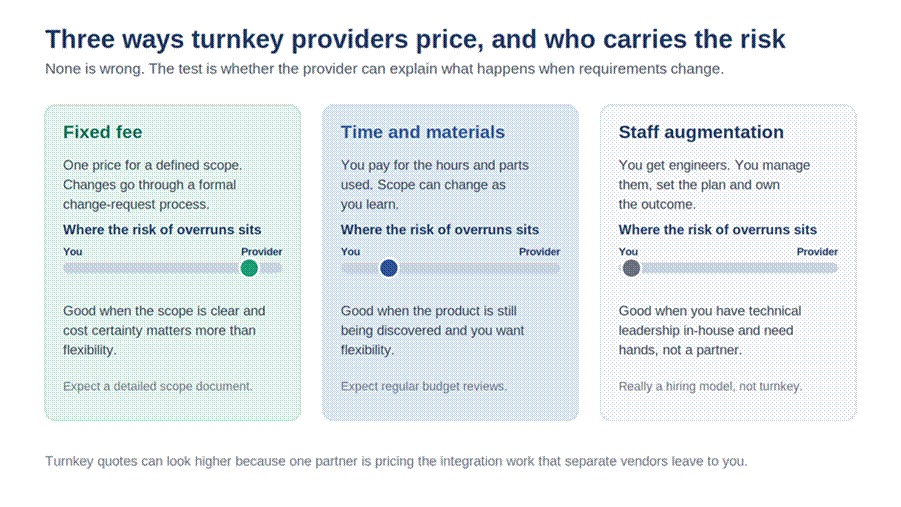
Who carries the risk of overruns under each pricing model.
None is wrong. The question is whether the provider can explain clearly what happens when the requirements change, because they will.
Once you have run these three questions, you are equipped for the conversations below. If you would like to run them on us, we are ready for it. Talk to sales
Top Turnkey Product Development Providers to Consider
Each entry follows the same format: services, headquarters, founding year, certifications and quality evidence, and who the provider is best for.
1. LIFO Technologies
LIFO Technologies is a Chennai-based deep-tech engineering company founded in 2011, with about 55 engineers. It grew out of embedded and IT services into what it now calls "chip to cloud": the same team designs the board, writes the firmware, tests the device, and builds the vision AI and cloud software that sits above it. Manufacturing is handled through established partners, with LIFO owning the design-for-manufacturability work and the production test development that make the handover to a factory predictable.
The reason LIFO is on this list is the In-House Test itself. The two disciplines that most need to stay together, electronics and firmware, are in one team, and the testing that proves them is in the same building. That is what allowed a railway-grade event logger and an unattended LPG vending fleet to be delivered without a second vendor in the middle.
Services: Embedded hardware design (schematics, PCB layout), firmware engineering, functional testing and validation (including hardware-in-the-loop and environmental stress screening), AI and computer vision, and the cloud and application software that sits above the device. LIFO describes this as "chip to cloud". Manufacturing is handled through established manufacturing partners, with LIFO owning the design for manufacturability work and production test development.
Headquarters: Chennai, India, serving clients in India, the USA, the UAE and Australia.
Founded: 2011.
Certifications and quality evidence: No ISO certification yet. What LIFO shows instead is the record a certificate stands for: an event logger delivered to railway-grade reliability requirements for Kavach, sensor-gated safety logic proven across BPCL's vending fleet, and design reviews and test reports from in-house hardware-in-the-loop, environmental stress and EMC pre-compliance testing, all available for a prospective client to inspect. We suggest asking every provider on this list for the same.
Named work: The event logger for Kavach, Indian Railways' train protection system, built to railway-grade reliability with tamper-evident storage; and automated LPG cylinder vending machines deployed by BPCL across multiple sites, with sensor-gated safety logic and remote diagnostics. Both were delivered with hardware and firmware owned by one team.
Strengths: electronics, firmware, testing and AI software in one team; safety-critical and unattended-fleet delivery record; direct access to the engineers.
Trade-off: no ISO certification yet, and manufacturing is through partners rather than in-house.
Best for: Embedded and connected products where the electronics, firmware and testing need to be owned by a single engineering team, and where the client wants clear answers to the In-House Test. Disclosure: this is our company.
2. eInfochips
eInfochips is one of India's largest product engineering companies, founded in Ahmedabad in 1994 and part of Arrow Electronics since 2018. Its practice covers the full journey from silicon and hardware design through firmware, application software and cloud, with strong groups in medical devices, industrial automation and semiconductor engineering. Being owned by a component distributor gives it something most engineering firms lack: a direct line into the supply chain that a product will depend on at volume.
For a large organisation with a multi-year product roadmap, that combination of scale, process and sourcing is hard to beat. For a single product with a tight budget, the same scale means more overhead than the job needs.
Services: Product engineering across hardware, firmware, software and cloud, with strong practices in semiconductor, medical devices and industrial automation.
Headquarters: Ahmedabad, India, part of Arrow Electronics, with delivery centres worldwide.
Founded: 1994.
Certifications and quality evidence: Publicly lists quality system certifications relevant to medical and industrial work; check the current list on its site.
Strengths: scale, mature process, medical and industrial practices, Arrow's supply chain.
Trade-off: overhead that a single, budget-constrained product does not need.
Best for: Enterprises that want a large, process-driven partner with the scale to run multi-year product programmes, and access to a component distributor's supply chain.
3. Mistral Solutions
Mistral Solutions has been designing embedded products in Bengaluru since 1997, with a long record in defence and aerospace electronics where boards are complex, environments are harsh and documentation is demanding. Its work runs from hardware and board design through firmware and system integration, and it has built a reputation for high-performance computing designs that most general engineering firms would not attempt.
Mistral is at its best when the electronics are the hard part. If your product's difficulty lies in a dense, high-speed board or a ruggedised design, it is a strong candidate. If the difficulty lies in industrial design and user experience, its centre of gravity is elsewhere.
Services: Embedded product design, from hardware and board design through firmware and system integration, with a long history in defence and aerospace electronics.
Headquarters: Bengaluru, India.
Founded: 1997.
Certifications and quality evidence: Publicly lists quality certifications appropriate to defence and aerospace work; verify current status.
Strengths: complex board design, ruggedised and high-performance electronics, defence and aerospace documentation experience.
Trade-off: industrial design and consumer user experience are not its focus.
Best for: Complex electronics, particularly in defence, aerospace and high-performance computing, where board design depth matters more than industrial design.
4. Softeq
Softeq, founded in Houston in 1997, is a full-stack development company that builds the hardware, the firmware, the mobile and web applications and the cloud services of a connected product, with engineering centres in Europe. Its turnkey offer includes prototyping and manufacturing coordination, so a client can go from an idea to units in hand with one contract.
That breadth is the attraction. Consumer and commercial IoT products live or die on the app experience as much as on the device, and Softeq covers both. The trade-off is that it is a generalist: for a safety-critical or heavily regulated device, a specialist with a delivery record in that category will bring more depth.
Services: Full-stack development covering hardware, firmware, mobile and web applications, and cloud, with prototyping and manufacturing coordination.
Headquarters: Houston, USA, with engineering centres in Europe.
Founded: 1997.
Certifications and quality evidence: Check the current list on its site and ask for named project records.
Strengths: device, app and cloud from one contract; prototyping and manufacturing coordination; US front office with European engineering.
Trade-off: generalist; regulated or safety-critical categories want a specialist with a record in that category.
Best for: Startups and mid-sized companies building connected products where the app and cloud experience is as important as the device.
5. StudioRed
StudioRed is a Silicon Valley design and engineering consultancy founded in 1983, which makes it one of the longest-running firms in this category. Its strength is industrial design and mechanical engineering: the shape, feel and manufacturability of a physical product, carried through prototyping into production support, with electronics brought in through partners.
Its own listing of product development companies is one of the reference points for this article, and it is refreshingly clear about what it does and does not do. StudioRed is the right partner when the physical design leads and the electronics are relatively standard. It is not the right partner when the firmware is the hard part.
Services: Industrial design, mechanical engineering, prototyping and manufacturing support, with electronics through partners.
Headquarters: Silicon Valley, USA.
Founded: 1983. Self-reports more than 3,500 projects and over 450 launched products, with named clients including Meta, Medtronic and Boston Scientific.
Certifications and quality evidence: Check the current list on its site and ask for named project records.
Strengths: four decades of industrial design and mechanical engineering, strong prototyping, honest scoping.
Trade-off: electronics and firmware come through partners, so the In-House Test needs asking here too.
Best for: Products where the physical design and user experience lead, and the electronics are relatively standard.
6. Cyient
Cyient is a Hyderabad-headquartered engineering services group founded in 1991, with global operations and a listed manufacturing arm that gives it electronics design and electronics manufacturing under one corporate roof. That is rare. Most turnkey providers either design or make; Cyient can do both, which matters for regulated programmes where design transfer to a separate manufacturer is itself a source of risk.
Its sweet spot is large programmes in aerospace, rail, medical and utilities, where certification, traceability and long-term supply matter more than speed. A start-up building its first connected device will find Cyient's scale and process heavier than it needs.
Services: Engineering services spanning electronics design, embedded software and, through its manufacturing arm, electronics manufacturing, giving it design and production under one corporate roof.
Headquarters: Hyderabad, India, with global operations.
Founded: 1991.
Certifications and quality evidence: Publicly lists aerospace, automotive and medical quality certifications; verify current status for your category.
Strengths: design and manufacturing under one group, regulated-sector process, global capacity.
Trade-off: scale and process are heavier than an early-stage product needs.
Best for: Large regulated programmes that want design and manufacturing from one corporate group, particularly in aerospace, rail and medical.
Benefits of Working With a Turnkey Partner
When the partner really does own the core disciplines, four things get better.
• One accountable owner. When something does not work, there is one phone call to make, and nobody can point at another vendor.
• Fewer handoffs. Electronics, firmware and testing designed together means fewer surprises at integration and fewer board revisions.
• Certification designed in. A partner that has taken products through FCC, CE or BIS designs for those tests from the first schematic rather than discovering them at the end.
• A shorter path to manufacturing. Design for manufacturability and production test fixtures are part of the same project, so the handover to the factory is planned rather than improvised.
The flip side is that these benefits only appear when the disciplines are actually in-house, which is why the In-House Test comes first.
FAQ
What is the difference between turnkey product development and contract manufacturing?
Contract manufacturing builds a design you already have. Turnkey product development creates the design, proves it, and takes it into production. If your product does not exist yet, you need the second.
What certifications should a turnkey product development partner hold?
For regulated categories, the certificate your category requires: ISO 13485 for medical, IATF 16949 for automotive, AS9100 for aerospace. For other products, ISO 9001 is a useful signal but not the only one; documented design reviews, test records, and prior FCC, CE or BIS approvals on shipped products tell you the same thing. Ask to see them.
How long does turnkey product development take?
For a moderately complex embedded product, roughly 6 to 12 months from requirements to a production-ready design, and longer, often 12 to 24 months, for medical, automotive or aerospace products because of certification cycles.
Is turnkey product development more expensive than hiring separate vendors?
The quotes can look higher because one partner is pricing the whole job, including the integration work that separate vendors leave to you. Counting the time you would spend managing handoffs and the cost of integration problems, turnkey is often cheaper overall for embedded products.
What is the difference between a design agency and a turnkey product development company?
A design agency delivers the look and mechanical design and hands off the rest. A turnkey company delivers the electronics, firmware, testing and manufacturing readiness as well, and is accountable for the product working.
Conclusion
The word "turnkey" is on every provider's site, including ours. What separates a real turnkey partner from a coordinator of subcontractors is what they own in-house, and the only way to find out is to ask. Use the three questions above on every provider you talk to, and pay particular attention to whether electronics and firmware live in the same team.
If you want to put those questions to us, LIFO's team is happy to answer them with specifics, and to walk you through the projects above. Talk to sales