
Key Takeaways:
- The single most useful question to ask any provider of firmware development services is whether the people writing the firmware are the same people who designed the board.
- Beyond that, check platform and RTOS breadth, board bring-up track record, and real safety-critical delivery history.
- This article explains the question, gives you a vetting checklist, groups the main types of provider, and shows two projects where one team owned both hardware and firmware.
If you are a CTO or engineering lead searching for firmware development services, you probably have a specific problem. Firmware that works on the bench but fails in the field. A team that knows one chip family and needs to move to another. A prototype that has to become a product, and the code that made the demo work is nowhere near good enough to ship ten thousand units.
You have probably also read a couple of "top firmware companies" lists today and noticed they either repeat the same enterprise IT names or show scores with no evidence behind them. This is a different kind of article. It gives you one question that predicts most firmware failures, a short checklist you can use on a vendor call, and an honest map of who does this work, including us.
Comparison at a Glance
| Provider type | Examples | Strengths | Trade-offs | Best for |
| Integrated hardware and firmware team | LIFO Technologies (Chennai, India) | One team owns board and firmware; safety-critical and legacy modernisation proof; serves India, USA, UAE, Australia | Mid-sized team, not a thousand-person bench | Products where integration risk is the main risk |
| Global enterprise IT services | Capgemini, TCS, Accenture | Scale, governance, multi-stream programmes | Process overhead on small firmware-only scopes | Large programmes where firmware is one stream of many |
| RTOS and platform vendors | NXP, Wind River, QNX | Pre-qualified, safety-certified platforms and professional services | Strongest only on their own platform | Safety-certified products where the qualified RTOS is the deciding factor |
| Boutique embedded specialists | Conclusive Engineering, Lemberg Solutions, Axio Electronics | Deep technical focus, named silicon partnerships | Limited capacity and availability | Focused firmware projects where depth beats scale |
What Firmware Development Services Actually Cover
Firmware development services are engineering services that write, test, and maintain the low-level software that runs directly on a device's hardware. That includes device drivers (the code that talks to sensors, displays and radios), communication stacks (the code that implements protocols such as Bluetooth or CAN), bootloaders (the code that starts the device and installs updates), real-time operating system (RTOS) integration, and the application logic on top.
If you are not an engineer, here is the short version. Firmware is the software that lives inside a physical thing. It is written for one specific board, it has to fit in very little memory, and it has to respond in real time. It is different from app development the way building an engine is different from building a website.
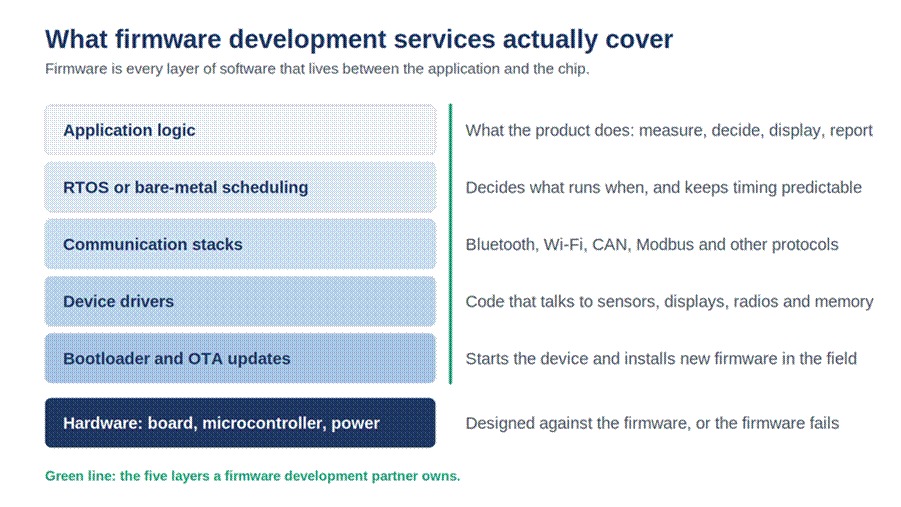
The five layers a firmware partner owns, and the hardware they are written against.
Who Needs Firmware Development Services
Four situations account for most of the companies that go looking for outside firmware help.
• A first product. A startup or a new division has a working proof of concept and needs it turned into firmware that can ship, update in the field, and pass certification.
• A legacy product. Equipment that has been in service for years is running on chips that can no longer be bought, and the firmware has to be moved to new hardware without changing how the product behaves.
• A platform change. The team knows one microcontroller family well and the next product needs a different one, or needs an RTOS for the first time.
• A regulated product. Automotive, medical, rail or industrial products need firmware developed and documented to a safety standard the in-house team has not worked to before.
If you recognise your situation in that list, the rest of this article is about choosing well.
Examples of Integrated Hardware-Firmware Delivery Projects
Here are two projects where the same LIFO team designed the board and wrote the firmware, and what that made possible.
Tamper-evident firmware for a safety-critical railway event logger (Kavach)
Kavach is Indian Railways' automatic train protection system. Every safety-relevant event has to be recorded with an accurate timestamp, in a way that cannot be altered afterwards, on hardware that will spend years in heat, dust and vibration on a moving train.
LIFO designed the event logger hardware and wrote its firmware. The firmware implements tamper-evident storage, so any attempt to modify the record is detectable, and handles power interruptions without losing or corrupting events. Because the same engineers chose the memory parts and the power circuitry, the firmware's assumptions about how the hardware behaves during a brownout were correct from the first board, not discovered in the field.
Reviving 50-year-old hardware with firmware that behaves exactly like the original (Newco Coffee)
Newco Coffee had equipment built on hardware that was decades old, still in use, and increasingly impossible to repair. The requirement was unusual: replace the electronics with a modern board, but make it behave exactly like the original, so operators and the surrounding machinery would notice no difference.
LIFO built the replacement board and wrote firmware that replicated the original behaviour precisely, then added remote monitoring the old hardware never had. Matching behaviour that exactly is only possible when the people writing the firmware can also change the hardware, and vice versa, because the two are tuned together.
If either of these sounds like your problem, a board that needs firmware it can trust, or a product that needs to move from prototype to production without a second vendor in the middle, talk to our team. Talk to sales
Top Firmware Development Services to Evaluate in 2026
Rather than rank companies against each other, we have grouped them by type, because the right type depends on your situation. We start with ourselves, and we say so.
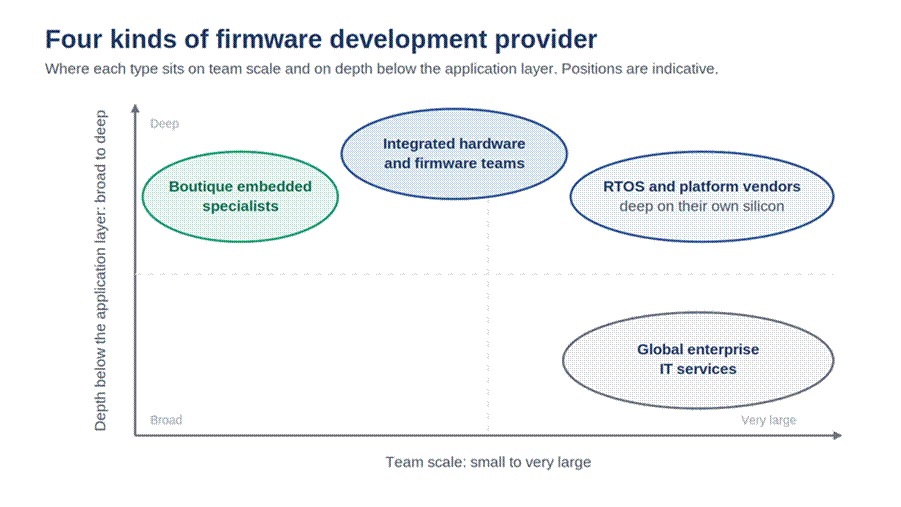
Four kinds of provider. Positions are indicative, not a ranking.
LIFO Technologies: firmware built by the same team that owns the board
LIFO Technologies is an embedded engineering company based in Chennai, India, serving clients in India, the USA, the UAE and Australia. We design hardware and write the firmware for it, in one team.
Core expertise: bare-metal and RTOS firmware, device drivers, communication stacks, bootloaders, and over-the-air (OTA) update frameworks, delivered alongside the hardware design and functional testing for the same product.
Platforms: STM32, ARM Cortex-M, AVR and PIC microcontrollers; FreeRTOS and other RTOS options as the product needs.
Named proof: the Kavach railway event logger (safety-critical, tamper-evident storage) and the Newco Coffee legacy board revival, both described later in this article and both delivered end to end by engineers who also built the boards.
Disclosure: this is our company, and this article exists partly so you find us. Judge the entry by the checklist above, the same way you would judge anyone else's.
Best fit for: companies that specifically want hardware and firmware under one roof, and products where integration risk is the main risk.
Global enterprise IT-services vendors
These are very large organisations with embedded practices inside them. They exist for programmes measured in hundreds of engineers, and that scale is both the attraction and the cost.
Capgemini Engineering: firmware inside large automotive and aerospace programmes

Capgemini's engineering arm was formed when the Paris-based group absorbed Altran in 2020, which brought in one of Europe's largest pools of automotive and aerospace engineers. Embedded software sits inside that practice alongside mechanical design, systems engineering and manufacturing consulting, so firmware is rarely bought on its own. It arrives as one stream in a programme that also covers vehicle architecture, compliance and supplier management.
That is the right shape for a carmaker consolidating dozens of control units into a few central computers, or an aerospace supplier that needs DO-178C documentation produced at volume. It is the wrong shape for a company that needs six firmware engineers for nine months.
Strengths: deep automotive and aerospace bench, formal safety and compliance processes, ability to staff and govern very large programmes.
Trade-off: onboarding, contracting and reporting layers built for large accounts; a small firmware scope can spend more time in process than in engineering.
Best fit for: OEMs and tier-one suppliers running multi-year, multi-discipline programmes where firmware is one part of a much bigger delivery.
Tata Consultancy Services: embedded engineering at outsourcing scale
TCS runs embedded work under its engineering and industrial services unit, which serves automotive, industrial, medical and aerospace clients from a large base in India and delivery centres worldwide. The model is long-term managed engineering: dedicated teams that take over a product line's software maintenance, platform migrations and feature development for years at a time, with mature processes for handovers between shifts and sites.
For a company with a large installed base of devices to keep alive, that continuity matters. TCS can absorb a hundred-person legacy firmware estate and run it predictably. It is less suited to the early, messy phase of a new product, where the board is still changing and the team needs to sit next to the hardware engineers.
Strengths: scale, process maturity, cost-effective long-term maintenance, strong automotive and industrial client list.
Trade-off: distance from the hardware; a new product with an unstable board benefits from a smaller team that owns both sides.
Best fit for: enterprises with large legacy firmware estates, platform migrations, or multi-year sustaining engineering needs.
Accenture: embedded as part of a digital product transformation
Accenture approaches embedded software through its Industry X practice, which is built around connected products, digital twins and smart manufacturing rather than firmware for its own sake. The typical engagement starts with a business transformation, for example making a fleet of industrial machines connected and serviceable remotely, and the firmware work is scoped as part of delivering that outcome, next to cloud platforms, data and change management.
That framing suits a company whose real problem is strategic: how to turn products into services, or how to bring an ageing product line into a connected platform. If the problem is narrower, say a driver that will not behave or a bootloader that needs securing, the engagement model is heavier than the job.
Strengths: strong at linking device software to cloud, data and business outcomes; global delivery; consulting-led scoping.
Trade-off: the engagement wraps firmware inside a transformation programme; buyers wanting focused, low-level engineering will find the model expensive for what they need.
Best fit for: large organisations connecting existing product lines to digital platforms, where firmware, cloud and business change need one accountable partner.
RTOS and platform vendors
Sometimes the right answer is the ecosystem itself. These vendors sell the operating system or the silicon, and offer professional services and pre-qualified platforms around it. Their limitation is the mirror of their strength: they are excellent on their own platform and only their own platform.
NXP Semiconductors: firmware support built into the silicon
NXP is not a services firm, but it belongs on any firmware list because so much embedded work runs on its chips. The Eindhoven-based company describes itself as the leader in automotive processing and networking, and it ships a complete software stack around its microcontrollers and processors: SDKs, middleware, RTOS support, AUTOSAR integration and the MCUXpresso toolchain, all tuned to its own hardware.
NXP has been moving from chips toward full platforms for software-defined vehicles. In 2025 it acquired TTTech Auto, a safety and security software specialist, to strengthen its CoreRide platform, which aims to cut integration effort for carmakers. For a team already on NXP silicon, that means board support packages, drivers and reference designs that shorten bring-up considerably.
Strengths: tight hardware and software integration, long-term support commitments, wide footprint in automotive and industrial IoT.
Trade-off: the software is optimised for NXP hardware; a product that spans several chip vendors, or needs a lot of custom driver work, gets less from the ecosystem.
Best fit for: products standardising on NXP silicon, especially automotive and industrial designs that want a supported path from reference design to production.
Wind River: VxWorks for firmware that has to be certified
Wind River is one of the oldest names in real-time operating systems, and VxWorks remains the reference RTOS for aerospace, defence and industrial systems where a missed deadline is a safety event. It has flown on NASA missions, and it keeps winning new work in demanding programmes: in 2025 the aerospace and defence group Leonardo selected VxWorks for a multicore radio system that requires DO-178C DAL C certification.
VxWorks is built for backward compatibility, which matters in programmes where hardware refresh cycles run a decade or more, and it supports single-core and multicore designs across several processor families. Wind River's professional services help teams build on that base, but the value is the certified platform rather than custom firmware written from scratch.
Strengths: decades of flight heritage, strong certification record, mature tooling for multicore and safety-critical work.
Trade-off: licensing and certification overhead make it a heavy commitment for consumer or short-lifecycle products that will never need DO-178C.
Best fit for: aerospace, defence and industrial products where a pre-qualified RTOS is the deciding factor and the certification evidence has to exist from day one.
Boutique embedded specialists
These are small, technical firms. They tend to be deep on a few platforms, have engineers who have shipped many boards, and often hold named partnerships with silicon vendors. The trade-off is capacity: a boutique may not be able to grow past a certain team size, and availability depends on what else is in the shop.
Conclusive Engineering: embedded Linux and custom boards from one small team
Conclusive Engineering is a Poland-based firm that builds custom embedded hardware and the low-level software to run it, with a particular emphasis on embedded Linux: board support packages, Yocto-based builds, bootloaders and driver work for custom system-on-module designs. The company also takes on FPGA and mixed hardware-software projects, and it keeps hardware design and firmware in the same team, which is the model this article argues for.
Conclusive publishes its own ranking of firmware companies, in which it places itself first, so read its self-description with that in mind. What is verifiable is the shape of its work: small teams, deep Linux and board-level expertise, and a client list weighted toward industrial and networking products rather than consumer gadgets.
Strengths: hardware and firmware under one roof at boutique scale, strong embedded Linux depth, direct access to senior engineers.
Trade-off: limited capacity; not the right fit for a programme that needs to scale to dozens of engineers or needs formal safety-standard delivery history.
Best fit for: custom Linux-based devices where the board and the BSP need to be designed together by a small, senior team.
Lemberg Solutions: firmware plus the app and cloud around it
Lemberg Solutions is based in Lviv, Ukraine, and covers the full connected-product stack: PCB design, firmware, wireless connectivity, and the mobile and web software that sits on top. That breadth is unusual for a boutique. Most small embedded firms stop at the device; Lemberg carries on to the app and the cloud, which suits products where the user experience is as important as the electronics.
The firm has a long record in IoT and consumer devices, and it has invested in a research and development group that prototypes new sensor and connectivity concepts before they reach a client project. The trade-off of that breadth is that the firmware team is one part of a wider software company rather than the whole of it.
Strengths: device, app and cloud from one vendor; wireless and IoT experience; strong prototyping culture.
Trade-off: firmware is one discipline among several; a project that is purely low-level and safety-critical may want a narrower specialist.
Best fit for: connected consumer and IoT products where one partner should cover the device and everything the user touches.
Axio Electronics: hardware and firmware design services from Pune
Axio Electronics is a Pune-based embedded design services firm offering hardware design, firmware development and product engineering for industrial, automotive and IoT clients. It works close to the board: schematics, layout, bring-up and the firmware that makes the hardware usable, with the two disciplines in one team.
For Indian and regional buyers it is a practical option for focused hardware-plus-firmware projects, and its size means direct access to the engineers doing the work. Like most boutiques, its ceiling is capacity and the depth of its documented delivery on formal safety standards.
Strengths: integrated hardware and firmware design, direct engineering access, regional proximity for Indian buyers.
Trade-off: small team; check availability and ask for named projects in your product category before committing.
Best fit for: focused embedded design projects where a compact, board-level team is the right size for the job.
The One Question That Predicts Most Firmware Failures
Ask this: Are the hardware team and the firmware team the same people?
Firmware is written against assumptions about the hardware. What voltage the sensor runs at. How fast the bus can go. Which pin does what. When the people writing the firmware are the same people who chose those parts and laid out that board, the assumptions are correct, or they get corrected in the same room within an hour.
When they are separate companies, the assumptions are written down in a document, and documents are incomplete. The gap shows up at integration.
The "Frankenstein prototype" problem
Here is how it usually goes. A hardware vendor delivers a board. A firmware vendor delivers code. The touchscreen lags, or the Wi-Fi drops every few minutes. The firmware vendor says the board's power supply is noisy. The hardware vendor says the driver is polling too often. Both may be partly right. Neither owns the fix.
You, the customer, are now the integration engineer. You did not hire yourself for that job, and it is not what you are good at. Weeks go by. This is what engineers privately call a Frankenstein prototype: stitched together from parts that were each fine on their own.
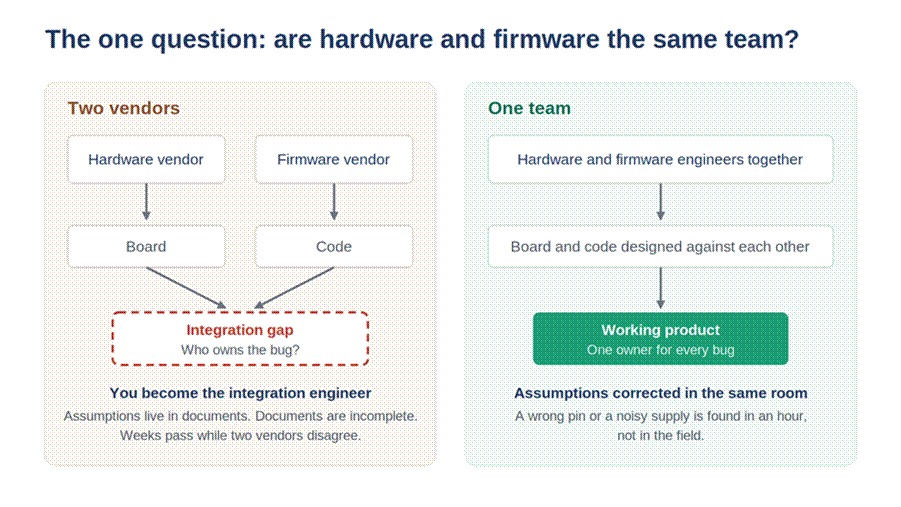
Two vendors leave an integration gap. One team closes it in the same room.
Why a long client-logo list is not proof of embedded depth
Many companies offering firmware development services are general software outsourcing firms that added "embedded" and "IoT" to the menu. They have impressive logos and polished case studies. What they often do not have is anyone who has argued with a datasheet at midnight or brought up a board that had a manufacturing defect on half its units.
Breadth of engagement is not depth of specialisation. A vendor that has done many projects for many industries may have done few of them below the application layer. The logo list tells you they can win business. It does not tell you they can reason about whether your product should run an RTOS or bare-metal code.
How to Vet a Firmware Development Partner
Use this on the first call. It takes ten minutes and tells you most of what you need to know.
Platform and RTOS breadth
Ask which microcontroller families they have shipped on: STM32, other ARM Cortex-M parts, AVR, PIC, ESP32, Nordic. Ask which RTOS options they have used in production (FreeRTOS, Zephyr, others) and when they would choose bare-metal instead.
You are not looking for a match to your exact chip. You are looking for breadth, because a team that has moved between chip families understands what is general and what is specific to one vendor's silicon. A team that only knows one platform has one answer to every question.
Board bring-up track record
Ask how many boards they have brought up from a bare PCB, and what went wrong on the last one. Everyone has a bring-up story. A team with real experience will tell you about the time the crystal did not start or the flash was wired backwards. A team without it will tell you bring-up is straightforward.
Production-transition proof
Ask for a project that went from prototype to volume manufacturing, and what changed in the firmware to get there. Production firmware needs a proper bootloader, a way to update devices in the field, a factory test mode, and error handling for every failure the bench never showed. If they cannot describe that transition, they have not made it.
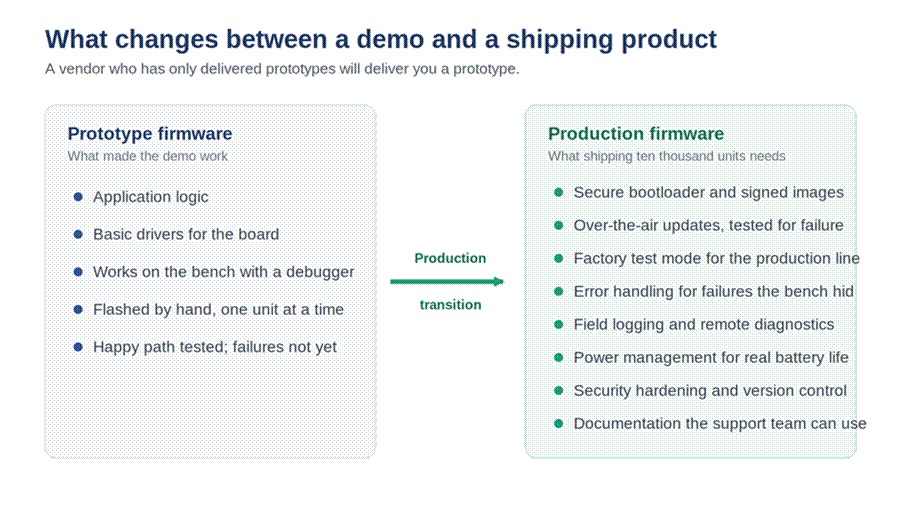
Prototype firmware proves the idea. Production firmware survives ten thousand units in the field.
Certifications and safety-critical delivery history
If your product is safety-related, ask about ISO 26262 (automotive), IEC 61508 (industrial), IEC 62304 (medical), or DO-178C (aerospace). But do not stop at whether they can name the standard. Ask for a project delivered against it, and what evidence they produced. A standard listed on a website is a claim. A delivered project with a documented safety case is proof.
The same-team question
And, finally, ask whether hardware and firmware would be owned by the same team on your project. If the answer is "we partner with a hardware firm", ask who owns integration bugs. Listen carefully to the answer.
Five questions to ask on the first call
If you only have ten minutes, ask these and listen for specifics:
1. Which chip families have you shipped production firmware on in the last three years?
2. Tell me about your most recent board bring-up and what went wrong.
3. Which project went from prototype to volume, and what changed in the firmware to get there?
4. Who owns integration bugs if the hardware is designed elsewhere?
5. How will our devices be updated in the field, and who builds that?
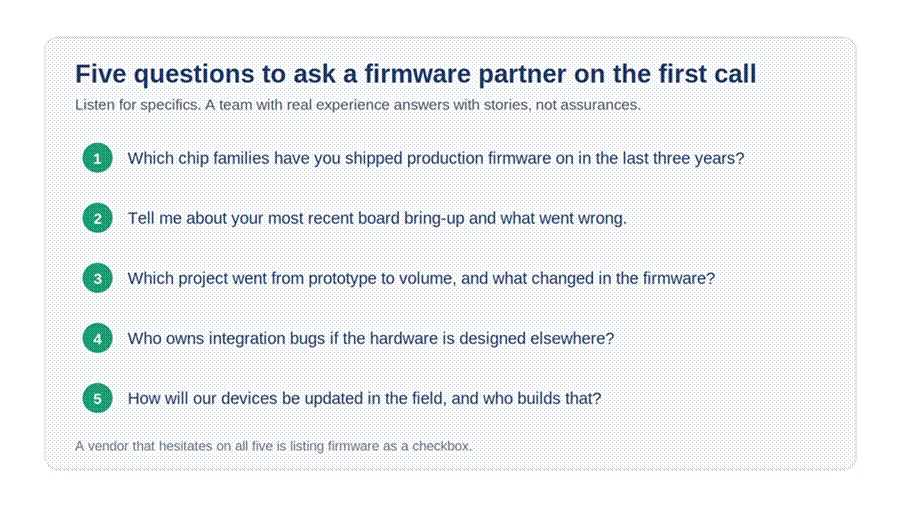
Ten minutes and five questions tell you most of what you need to know.
Conclusion
There are many competent providers of firmware development services, and this article has tried to sort them honestly by type. But if you take one thing from it, take the question: are the hardware and firmware teams the same people? It is the question no other list asks, and it is the one that most often predicts whether your product ships cleanly or spends three months in integration.
It also happens to be how LIFO is built. If you would like to talk through your project with a team that owns both, talk to sales. Talk to sales
FAQ
How much does firmware development cost?
It depends on scope. A single driver or a small feature might be a few weeks of one engineer's time. Full firmware for a new product, from bring-up to production-ready with OTA updates, is usually several engineers over several months. Get a scoped estimate against a written requirements list rather than an hourly rate.
What is the difference between embedded software and firmware?
Firmware is the lowest layer, tied directly to the hardware and stored in the device's memory. Embedded software is the broader term that includes firmware plus higher-level applications that may run on an embedded operating system. In everyday use, the two terms overlap heavily.
Should firmware development be outsourced or built in-house?
Build in-house if firmware is your core product and you can hire and retain the specialists. Outsource if you need depth on a platform you do not have, need capacity for a bounded project, or want one partner to own hardware and firmware together.
How do I choose a firmware development partner?
Ask whether hardware and firmware are the same team, check platform and RTOS breadth, ask for bring-up and production-transition stories, and verify safety-critical delivery with real projects rather than listed standards.
What questions should I ask a firmware development company before signing?
Which chip families have you shipped on? Tell me about your last board bring-up. Which project went from prototype to volume, and what changed in the firmware? Who owns integration bugs if the hardware is built elsewhere? How will devices be updated in the field?
Why does it matter if the hardware and firmware teams are the same company?
Because firmware is written against assumptions about the hardware, and when both are owned by one team those assumptions are right or get corrected quickly. When they are split, integration problems become disputes between vendors, and you end up managing the gap.