
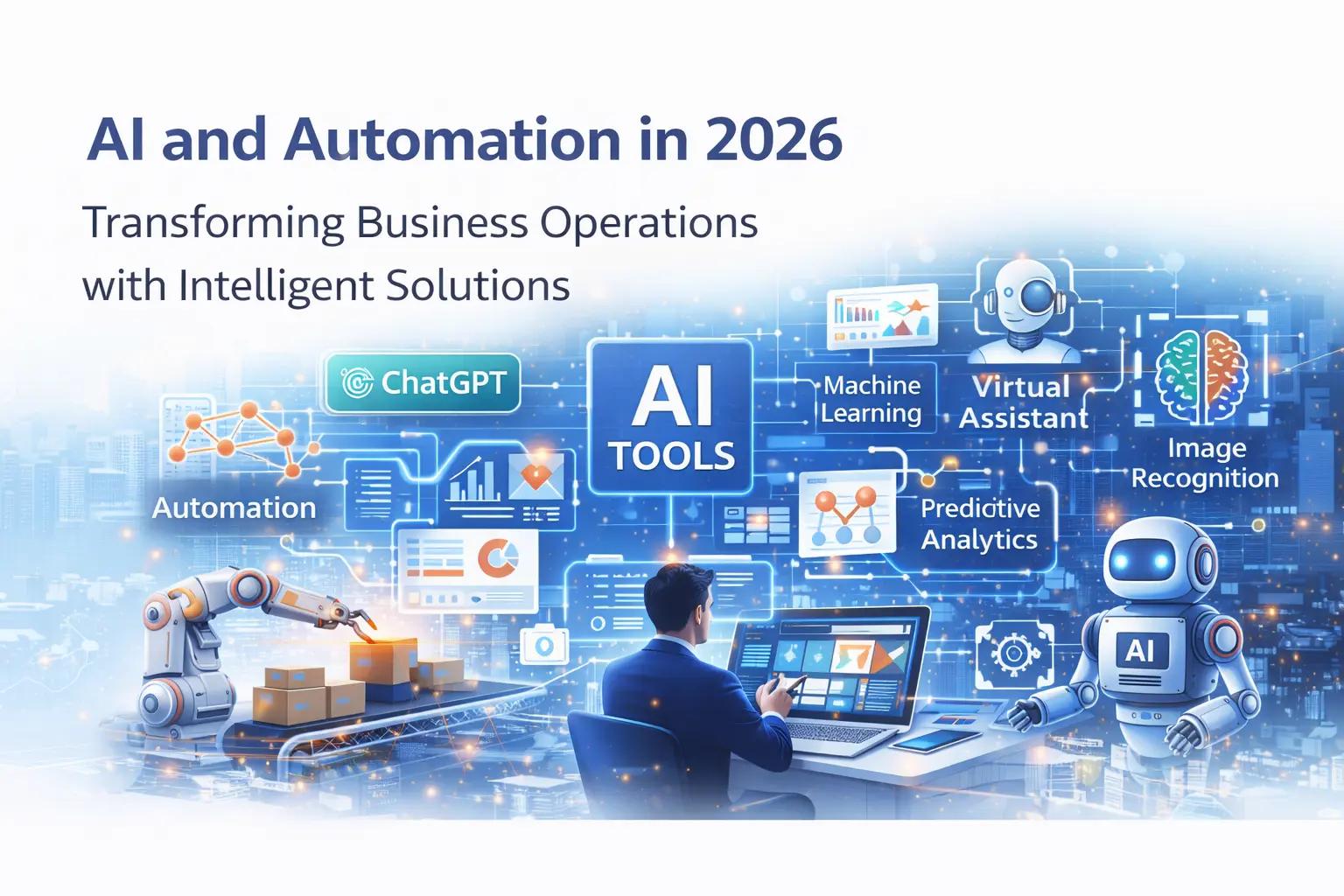
Artificial Intelligence (AI) has moved far beyond experimentation. In 2026, AI is becoming the backbone of enterprise innovation, operational efficiency, and competitive advantage. Organizations across manufacturing, automotive aftermarket, oil & gas, retail, cloud computing, software engineering, and embedded systems are leveraging AI to streamline operations, improve customer experiences, reduce costs, and accelerate decision-making.
The rapid evolution of AI technologies is creating new opportunities for businesses that are prepared to embrace digital transformation. From autonomous AI agents and multimodal intelligence to industrial AI and predictive analytics, the next wave of innovation is reshaping how organizations operate and compete.
In this article, we explore the Top 10 Artificial Intelligence Technology Trends in 2026 that every business owner, IT leader, and digital transformation strategist should understand.
1. AI Agents Become the New Digital Workforce
One of the most significant trends in 2026 is the rise of AI Agents.
Unlike traditional chatbots, AI agents can reason, plan, execute tasks, interact with multiple systems, and make contextual decisions with minimal human intervention.
Businesses are deploying AI agents to:
- Manage customer support operations
- Automate service requests
- Handle procurement workflows
- Monitor IT infrastructure
- Assist software development teams
- Coordinate supply chain activities
For enterprises, AI agents are becoming digital employees that work alongside human teams, increasing productivity while reducing operational costs.
Business Impact
Organizations implementing AI agents are experiencing:
- Faster response times
- Improved operational efficiency
- Reduced manual workload
- Enhanced customer satisfaction
- Lower support costs
2. Generative AI Evolves Beyond Content Creation
Generative AI is no longer limited to creating text, images, and videos.
In 2026, enterprises are using Generative AI for:
- Product design
- Engineering simulations
- Software code generation
- Business process automation
- Knowledge management
- Enterprise search systems
AI-powered development platforms are enabling software teams to accelerate application delivery while maintaining code quality and security standards.
For manufacturing and engineering industries, Generative AI is helping organizations rapidly prototype products and optimize designs before production.
Business Impact
Generative AI enables:
- Faster innovation cycles
- Reduced development costs
- Improved engineering productivity
- Accelerated product launches
3. Multimodal AI Becomes Mainstream
Modern AI systems can now process and understand multiple forms of data simultaneously, including:
- Text
- Images
- Video
- Audio
- Sensor data
- Documents
This capability is known as Multimodal AI.
Businesses are leveraging multimodal intelligence to create more sophisticated customer experiences and operational systems.
Examples include:
- Visual quality inspection in manufacturing
- Automated document processing
- Smart retail surveillance
- Voice-enabled enterprise assistants
- Vehicle diagnostics and predictive maintenance
Business Impact
Multimodal AI provides richer insights by combining diverse data sources, resulting in more accurate decision-making and automation.
4. Edge AI Accelerates Industrial Transformation
Edge AI is becoming a critical technology for organizations requiring real-time intelligence.
Instead of sending data to centralized cloud systems, AI models are deployed directly on:
- Industrial equipment
- IoT devices
- Embedded systems
- Smart cameras
- Vehicles
- Production machinery
This reduces latency and improves responsiveness.
Industries benefiting from Edge AI include:
- Manufacturing
- Automotive
- Oil & Gas
- Logistics
- Smart Infrastructure
Business Impact
Benefits include:
- Real-time decision making
- Lower cloud costs
- Improved reliability
- Enhanced data privacy
- Faster operational response
5. Predictive and Prescriptive Analytics Gain Momentum
Organizations are moving beyond descriptive reporting toward predictive and prescriptive intelligence.
AI systems can now:
- Predict equipment failures
- Forecast demand
- Optimize inventory
- Identify business risks
- Recommend corrective actions
In the manufacturing and automotive aftermarket industries, predictive maintenance is reducing downtime and improving asset utilization.
Business Impact
Predictive AI enables organizations to:
- Prevent costly disruptions
- Improve forecasting accuracy
- Optimize resource allocation
- Increase operational efficiency
6. AI-Powered Software Engineering
Software development is experiencing a major transformation through AI-assisted engineering.
Modern AI development tools help teams:
- Generate code
- Review software quality
- Detect vulnerabilities
- Create documentation
- Automate testing
- Accelerate deployment
Development teams are increasingly adopting AI-powered DevOps and software lifecycle management solutions.
Business Impact
Organizations benefit through:
- Faster release cycles
- Improved software quality
- Reduced development costs
- Increased developer productivity
7. Responsible AI and Governance Become Strategic Priorities
As AI adoption increases, governance and compliance are becoming business-critical concerns.
Organizations are investing in:
- AI governance frameworks
- Ethical AI practices
- Explainable AI
- Data security controls
- Model monitoring systems
Business leaders recognize that trustworthy AI is essential for maintaining customer confidence and regulatory compliance.
Key Focus Areas
- Transparency
- Fairness
- Accountability
- Security
- Privacy Protection
Business Impact
Responsible AI initiatives help organizations minimize risks while maximizing AI adoption.
8. Hyperautomation Expands Across Enterprises
Hyperautomation combines:
- Artificial Intelligence
- Robotic Process Automation (RPA)
- Machine Learning
- Business Process Management
- Intelligent Workflows
In 2026, organizations are automating entire business processes rather than isolated tasks.
Examples include:
- Invoice processing
- Customer onboarding
- Service center operations
- Claims management
- Procurement workflows
- HR operations
Business Impact
Hyperautomation delivers:
- Reduced operational costs
- Improved accuracy
- Faster processing times
- Enhanced employee productivity
9. Industry-Specific AI Solutions Drive Competitive Advantage
Generic AI tools are giving way to industry-specific AI platforms designed for unique business requirements.
Manufacturing
- Production optimization
- Quality control
- Predictive maintenance
Automotive Aftermarket
- Service center automation
- Warranty management
- Spare parts forecasting
- Technician assistance systems
Oil & Gas
- Asset monitoring
- Pipeline analytics
- Operational risk assessment
Retail
- Personalized recommendations
- Demand forecasting
- Inventory optimization
Industry-focused AI solutions are delivering higher business value because they address specific operational challenges.
Business Impact
Organizations gain:
- Faster ROI
- Better adoption rates
- Improved operational outcomes
10. Autonomous Enterprises Begin to Emerge
Perhaps the most transformative trend of 2026 is the emergence of autonomous enterprises.
AI systems are increasingly capable of:
- Monitoring operations
- Identifying issues
- Making recommendations
- Executing actions
- Learning from outcomes
While complete autonomy remains a long-term goal, many organizations are already implementing semi-autonomous business processes.
Examples include:
- Autonomous supply chains
- Self-healing IT infrastructure
- AI-driven production systems
- Intelligent customer engagement platforms
Business Impact
Autonomous enterprises achieve:
- Increased agility
- Faster decision-making
- Lower operational costs
- Improved scalability
What These Trends Mean for Business Leaders
AI is no longer a future investment—it is a present-day business necessity.
Organizations that strategically embrace Artificial Intelligence in 2026 will be better positioned to:
- Accelerate digital transformation
- Improve operational efficiency
- Enhance customer experiences
- Drive innovation
- Create new revenue opportunities
- Gain competitive advantages
Business leaders should focus on building AI roadmaps that align technology investments with measurable business outcomes.
How LIFO Technologies Helps Organizations Harness AI
At LIFO Technologies Pvt. Ltd., we help enterprises transform ideas into intelligent business solutions through advanced AI, software engineering, cloud technologies, embedded systems, and digital transformation services.
Our expertise includes:
- AI Strategy & Consulting
- Generative AI Solutions
- AI-Powered Business Applications
- Predictive Analytics Platforms
- Intelligent Automation Solutions
- Cloud & Edge AI Implementations
- Industrial AI Systems
- Custom Software Development
We work closely with organizations across manufacturing, automotive aftermarket, retail, oil & gas, and enterprise sectors to deliver scalable, secure, and future-ready AI solutions.
Conclusion
The Artificial Intelligence landscape in 2026 is defined by intelligent automation, autonomous decision-making, multimodal systems, industry-specific solutions, and AI-powered innovation.
Businesses that embrace these emerging trends today will be positioned to lead tomorrow's digital economy.
The question is no longer whether organizations should adopt AI. The real question is how quickly they can integrate AI into their business strategy to unlock growth, efficiency, and long-term competitive advantage.
The future belongs to organizations that successfully combine human expertise with artificial intelligence.
And that future has already begun.