
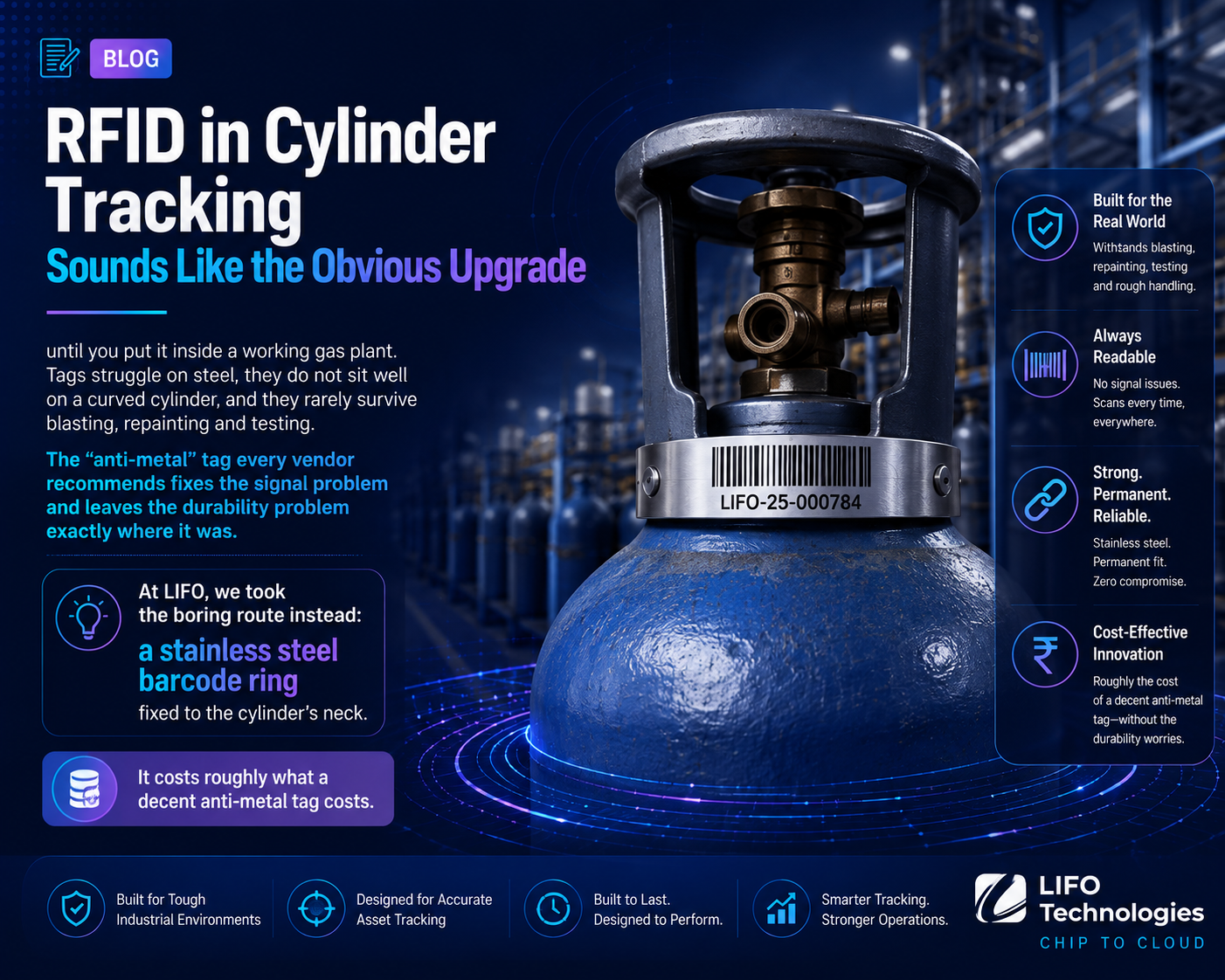
RFID in cylinder tracking sounds like the obvious upgrade until you put it inside a working gas plant. Tags struggle on steel, they do not sit well on a curved cylinder, and they rarely survive blasting, repainting and testing. The "anti-metal" tag every vendor recommends fixes the signal problem and leaves the durability problem exactly where it was.
At LIFO, we took the boring route instead: a stainless steel barcode ring fixed to the cylinder. It costs roughly what a decent anti-metal tag costs. The difference is that you buy it only once. It is running today with paying distributors including Chennai Oxygen, BOL, BHOX and Arasan Gas.
The pitch you have already heard
RFID means putting a small radio tag on each cylinder so a reader can identify it without anyone pointing anything at it. Drive a truck through a gate, and in theory the system logs forty cylinders in a second.
It is a good pitch. In a warehouse full of cardboard boxes, it is mostly true. The four selling points are always the same: no line of sight, bulk scanning, memory on the tag for test dates, and rugged housings for industrial use.
None of that is false. It was just all proved somewhere that looks nothing like your plant. Warehouses move light, non-metal goods, indoors, handled carefully, replaced within weeks. Your cylinder is thick welded steel, it lasts decades, it gets dropped off a truck bed, baked in a paint oven, filled under pressure, and sent to a customer who might sit on it for six months.
So the question is not whether RFID works. It is whether RFID works here.
Why a steel cylinder is the hardest place to put a tag
Three things about your cylinders work against RFID at the same time.
Steel gets in the way. A passive RFID tag has no battery. It borrows its power from the reader's radio signal. Press that tag flat against a large steel surface and most of that borrowed energy disappears, so the tag either reads from a few centimetres or does not wake up at all. This is basic radio behaviour, not a fault in any particular tag brand. It also means reads become a matter of probability rather than certainty. A gate that catches 97 percent of cylinders sounds excellent until ten thousand movements a month leaves you with three hundred fresh reconciliation gaps, which is the exact problem you were buying the system to fix.
Cylinders are curved. Tags are designed for a flat surface. A cylinder does not have one. Bend a tag around the body and it stops working properly. Mount it on a rigid block to keep it flat and it now sticks out, right in the path of every knock the cylinder takes. Stick it to the paint and your identity only lasts as long as the paint does.
The refurbishment cycle destroys it. This is the part no RFID buyer's guide mentions, because tag manufacturers do not run filling plants. Under the Gas Cylinders Rules, 2016, a cylinder cannot be filled unless it has passed its periodic hydrostatic test within the prescribed interval, and the test date has to be physically stamped on the cylinder. Getting to that stamp means shot blasting to strip off old paint and rust, which is a process built specifically to remove anything stuck to steel, followed by repainting and oven curing at temperatures well above the 85°C ceiling most industrial tags are rated for.
Put plainly: tag the fleet, run one normal test cycle, then tag a large part of the fleet again. That is not bad luck. That is how your business already runs.
The anti-metal tag, and what it does not fix
Anti-metal tags are real and they do work. They put a spacer between the tag and the steel so the metal stops swallowing the signal. If you go ahead with RFID on cylinders, you will need them.
But they only solve the signal problem. They do not stop a tag from being knocked off by a dock worker, they do not survive a blasting line, they do not raise the temperature rating, and they do not help in a shed packed with steel racks and cylinders sitting shoulder to shoulder, where tags interfere with each other. They also cost more.
Worth saying here that there is another way to do this, because the rest of the argument only lands if you know an alternative exists. We built CATalytics around a steel ring fixed to the cylinder rather than a radio tag, for exactly these reasons.
Forget the price per tag. Ask how often you pay it.
Most RFID business cases are argued on the wrong number. Vendors quote you a per-tag price, you multiply it by your fleet, and the total looks manageable.
We are not going to pretend our steel ring is cheaper. Put an anti-metal tag and a stainless ring side by side and the unit costs are in the same neighbourhood. If price per cylinder were the whole story, this would be a coin toss.
It is not the whole story, for two reasons.
You buy the ring once. It goes on when the cylinder is registered and it stays there for the working life of the cylinder, through blasting, repainting and every test cycle. A tag has to be bought again each time one is destroyed or knocked off. That turns a one-time spend into a line item that never goes away. Lose fifteen percent of tags a year and you have quietly created a permanent tagging job inside your plant.
The tag is the cheap part. To get the bulk-scanning benefit that justified RFID in the first place, you also need UHF handhelds, fixed readers and antennas at the gate, software to turn radio reads into business events, integration into Tally, and an RF survey to tune all of it inside a shed full of steel. Barcode scanning needs a scanner or a phone. That gap is far wider than anything you will see on the tag quote.
And there is a failure that costs you more than either. A tag that has fallen off does not tell you it has fallen off. It simply leaves you with a cylinder your system cannot see, which is exactly where you started.
What we do differently: a steel ring, not a radio
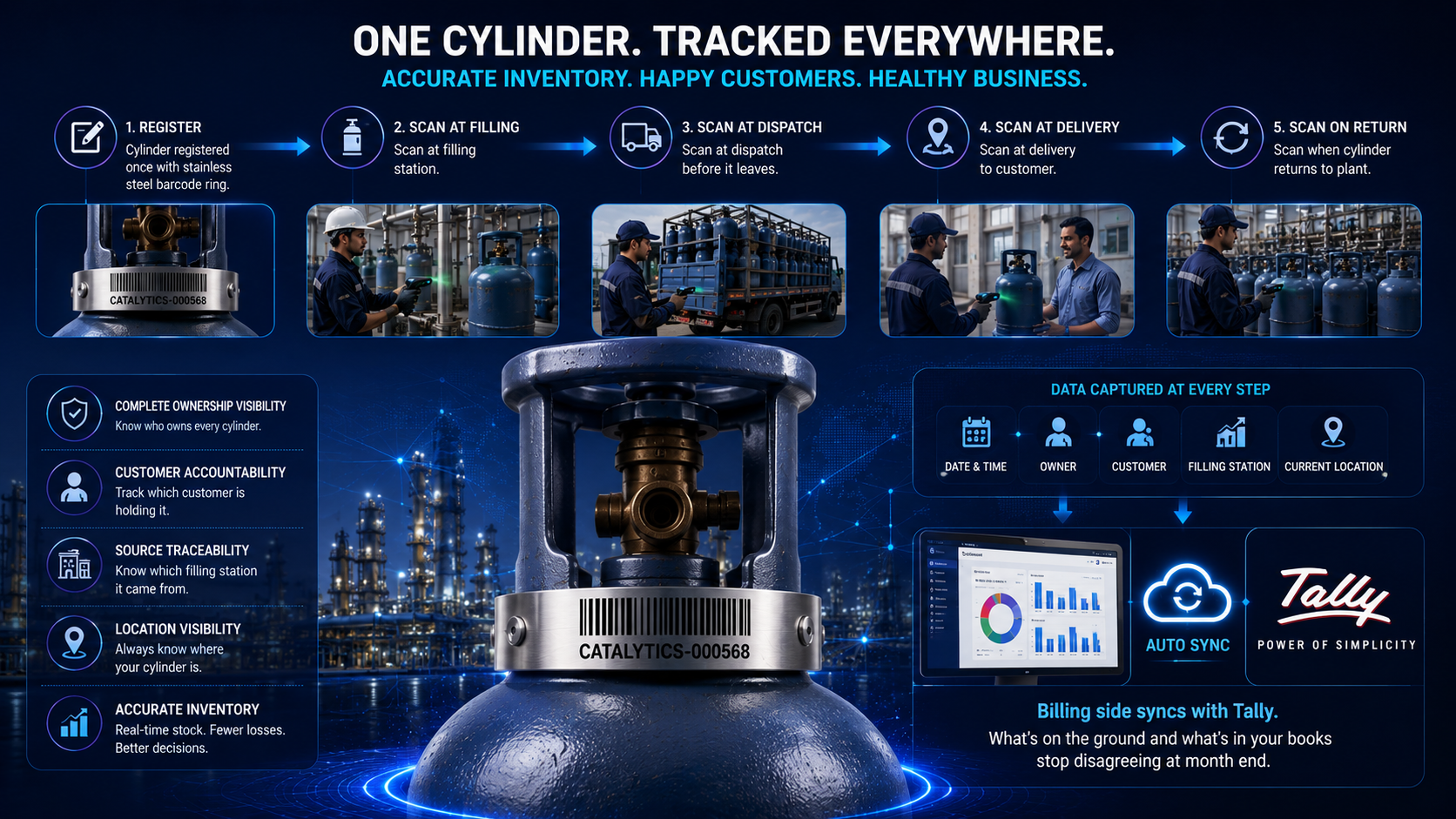
CATalytics gives every cylinder a stainless steel ring with a barcode on it. The cylinder is registered once when the ring goes on. After that the job is simple: scan at filling, scan at dispatch, scan at delivery, scan on return. Every scan records who owns the cylinder, which customer is holding it, which filling station it came from and where it is now. The billing side syncs with Tally, so what is on the ground and what is in your books stop disagreeing at month end.
That gets you the things a register never could. Which customer is holding how many cylinders and for how many days. Demurrage that calculates itself instead of being argued from memory. Turnaround by customer and by route. And an automatic warning when a cylinder's test date is coming up, so it never reaches a filling bay when it should not.
The ring is deliberately low-tech, in the same way the stamp on the cylinder shoulder is low-tech. Nothing to detune, nothing to interfere with, nothing to fall off. If a barcode gets dirty, someone wipes it and scans again, which takes five seconds. Compare that with a tag that silently fails to read and quietly tells your system the cylinder is not there.
There is a real trade-off and it is worth stating: you give up bulk scanning. Someone has to scan each cylinder. In our deployments that has been the better deal, because a scan happens at a real moment in the workflow and gives you a record you can trust, rather than a gate read you have to audit afterwards.
This is not a prototype. CATalytics is live with industrial and LPG distributors including Chennai Oxygen, BOL, BHOX and Arasan Gas.
RFID vs steel-ring barcode vs registers alone
| Register and Tally | RFID | CATalytics with SS ring | |
| Know where each cylinder is | No | When reads work | Yes, at every scan |
| Customer holding and days out | Manual, disputed | Yes | Automatic |
| Demurrage billing | From memory | Needs integration | Built in |
| Test-date expiry warnings | Diary and hope | Only if maintained | Automatic |
| Tally integration | Billing only | Custom work | Standard |
| Survives blasting and repainting | n/a | No | Yes |
| Survives rough handling | n/a | Falls off | Yes |
| How often you pay per cylinder | Never | Again each test cycle | Once |
| Equipment needed to read it | None | Handhelds, gate readers, antennas, RF tuning | A scanner or a phone |
| Bulk scanning | No | Yes | No |
Common questions
Does RFID work for gas cylinder tracking? In controlled conditions, yes. In a filling plant, reliability drops sharply and the cost of keeping it working never stops.
Why does RFID fail on metal cylinders? The tag draws its power from the reader's signal, and a large steel surface absorbs most of it. That is radio physics, not a bad product.
Is RFID better than barcode for cylinder tracking? RFID is faster at scanning in bulk. A barcode on a fixed steel ring is better at surviving your plant and at giving you records you do not have to double-check. For cylinders, durability matters more than speed.
What do RFID tags cost in India? Around ₹2.50 to ₹35 for basic tags and about ₹40 for anti-metal ones as of 2026, with rugged industrial versions higher. The tag price is the small part. Readers, gate antennas, software, integration and repeat purchases as tags are lost or destroyed are where the real spend sits.
Do I need anti-metal tags for cylinders? If you use RFID on steel cylinders, yes. Just know that they fix the signal problem only, and leave the falling-off, blasting and cost problems untouched.
How do distributors track cylinders without RFID? Give each cylinder a permanent physical identity, scan it every time it changes hands, and keep that data in a system that understands cylinder lifecycles instead of just invoices. That is what CATalytics does.
In short,
The industry keeps calling RFID the modern option and barcode the old one. In a gas plant it is the other way round. The radio tag is the fragile one, because it depends on a clean signal, good adhesive and a temperature limit you cannot control. The steel ring is the tough one, because it depends on steel.
In this environment, something that physically survives beats something that theoretically scans faster. That is why we built CATalytics, our cylinder tracking software, the way we did.
If you are weighing up an RFID pilot, look at the alternative that is already running.
Book a CATalytics demo. We will walk you through live cylinder tracking, holding and demurrage reports, test-date warnings and Tally sync, using your own fleet numbers.