
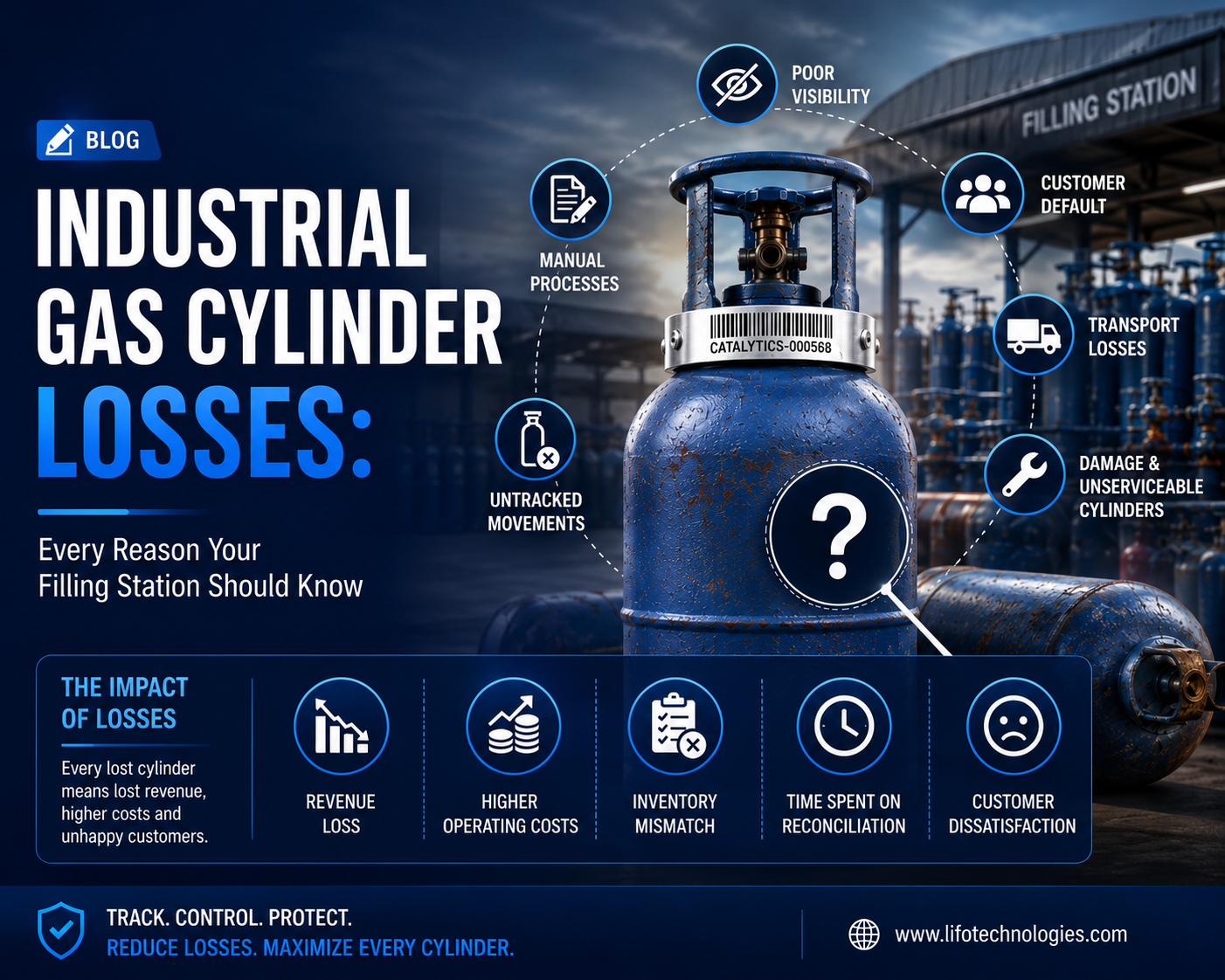
Industrial gas cylinder losses are the gap between gas produced or received in bulk and the net gas dispatched in filled cylinders, along with the cylinders themselves that quietly leave circulation. Losses at a filling station fall into six categories: filling and settlement errors, residual gas and purge losses, valve leaks, vent and blowdown losses, cylinder holding and rotation losses, and pilferage. In unmanaged fleets, cylinder losses can exceed 5% annually (BRI, 2026). The Gas Cylinder Rules, 2016 (PESO) define the compliance floor, and source-level attribution is what closes the gap.
Your monthly reconciliation shows a gap. Bulk product received, whether liquid oxygen, nitrogen, argon, CO2, or acetylene feedstock, does not match the net quantity dispatched in filled cylinders. Your cylinder ledger has its own gap: cylinders issued that have not come back, and cylinders on the books that no one can physically locate.
Before going further, one reframe matters more than any single fix. Industrial gas cylinder losses are not one problem. They are six overlapping problems that most filling stations manage as two aggregate numbers, a product variance and a cylinder count. Until you can attribute losses by source, you cannot fix them. You can only write explanatory notes.
This article gives you the full diagnostic: every loss source across the chain from bulk receipt to customer return, what the Gas Cylinder Rules require you to control, and how to calculate your station's loss per shift.
What Are Industrial Gas Cylinder Losses?
Industrial gas cylinder losses are the measurable gap between bulk gas received or produced and the net gas contained in filled, dispatched cylinders, expressed in kg, Nm³, or cylinder-equivalents per shift or per month. This is product loss. It is distinct from cylinder asset loss, which covers cylinders that leave effective circulation through non-return, overdue hydrostatic testing, cross-filling, or diversion. In industrial gas, the asset side is proportionally larger than in LPG, because your cylinder is a returnable capital asset that spends most of its life outside your gate.
Most stations track both gaps as aggregates. Almost none can break either down by source. That distinction separates a station that explains its losses from a station that reduces them.
Why Losses Are Hard to Attribute
The reconciliation gives you two numbers: product variance and cylinder count. The causes behind them span at least five separate systems, namely the filling manifold and its gauges or scales, the pre-fill inspection and purge line, the valve and leak-test point, the customer holding cycle, and the stock ledger. No single instrument watches all five.
So the diagnosis defaults to guesswork. The filling operators get blamed for the product gap, and "customers" get blamed for the cylinder gap. A recovery drive runs for a month, some cylinders come back, and the next quarter's numbers barely move, because the recovered cylinders addressed only one of four active loss sources while the other three were never on the table.
Root cause exercises restart with every audit cycle for exactly this reason. Aggregate data cannot support source-level conclusions, so stations end up fixing symptoms in rotation.
The 6 Main Causes of Industrial Gas Cylinder Losses
Losses at a filling station fall into six categories. Most stations are losing product or assets from at least three simultaneously, and typically do not know which is the largest contributor. Work through these in order. Together they form what we call the Six-Source Loss Model.
1. Filling Errors: Pressure Settlement and Scale Drift
Compressed gases (O2, N2, argon) are filled by pressure, while liquefied gases (CO2, N2O) are filled by weight. Both routes lose product systematically when their instruments drift.
On the pressure side, the failure mode is temperature settlement. A cylinder filled hot reads full at the manifold and reads short after it cools. Filling to working pressure without temperature compensation means every cylinder dispatched on a fast turnaround is underfilled, and every customer complaint about short cylinders traces back to your fill discipline rather than their meter. On the weight side, the familiar scale-drift logic of any weigh-fill operation applies: a drift of a few tens of grams never trips an alarm, but it compounds across every CO2 cylinder on the line, every shift.
Gauge calibration cadence is the control. If your master gauges and fill scales are checked periodically rather than every shift, this is the first place to look, though it is rarely the only place.
2. Residual Gas and Purge Losses
Every returned cylinder comes back with something in it: residual pressure, a contaminated heel, or moisture. What happens next is a structural loss source that most stations never measure.
Cylinders returned with usable residual gas are routinely vented to zero before refill, either because pre-fill inspection requires it or because segregating them is operationally inconvenient. Purity-critical fills such as medical oxygen, high-purity argon, and food-grade CO2 additionally require purge cycles of pressurising and venting, where every purge volume is product deliberately released to atmosphere. These losses are necessary, but they are almost never metered.
Unmeasured purge and vent losses get silently absorbed into the aggregate variance, where they are misattributed to filling errors or, worse, to staff. Metering the vent line is inexpensive, and the attribution clarity it buys is substantial.
3. Valve and O-Ring Leaks
Product filled correctly can still be lost before dispatch, and after it. Valve spindle leaks, seat leaks, and O-ring degradation bleed high-pressure product continuously, and at 150 to 200 bar, even a soap-bubble-grade leak on a single cylinder becomes a meaningful loss over a two-week holding period.
The Gas Cylinder Rules, 2016 require valves conforming to the relevant IS standards and leak testing before dispatch, so the control point exists at every station. The gap is coverage and logging. Sample-based soap testing catches gross leaks, but it does not catch the slow leaker that ships full and arrives at the customer 15% down, which then returns as a short-fill dispute booked against your filling line rather than your valve line. Without a per-cylinder leak-test record, those two failure modes cannot be told apart.
4. Vent and Blowdown Losses in Transfer
This category covers losses built into the transfer process itself.
Liquid transfer from bulk storage to the vaporiser or pump involves blowdown, line venting, and flash losses. Cascade and manifold filling strands product in dead legs and pigtails, which gets vented at every changeover. Acetylene plants carry their own version in generator and purifier losses. These are process losses rather than process errors, which means they cannot be disciplined away, only engineered down and measured.
They belong in your attribution model for one reason: unmeasured transfer losses are real, recurring, and invisible, and when they go unquantified they inflate every other category's apparent contribution, which corrodes both your data and your team's trust in it.
5. Cylinder Holding, Rotation, and Test-Due Losses
In industrial gas this is usually the largest category, and the least visible, because nothing is leaking. The asset itself simply stops earning.
Cylinders sit at customer sites beyond agreed holding periods, unrotated and unbilled. Industry data puts cylinder losses in unmanaged fleets above 5% annually, with return and recertification losses exceeding 7% of circulating fleets in some markets (BRI, 2026). Two mechanisms drive this. The first is holdership: without per-cylinder issue and return records, demurrage is unbillable, and long-holding customers face no cost for sitting on your fleet. The second is test-due attrition: under the Gas Cylinder Rules, cylinders past their hydrostatic or periodic test date cannot legally be filled, so every overdue cylinder is capacity you own but cannot use. Stations without test-date tracking routinely discover the backlog only when a PESO inspection or a filling refusal forces the count.
A cylinder that spends 300 days a year at customer sites and comes back test-expired has cost you twice. Manual registers cannot police either mechanism at fleet scale.
6. Pilferage and Stock Discrepancies
This category deserves a factual framing, because the data supports one. At high-volume stations, small per-cylinder diversions aggregate into significant monthly losses, and manual stock reconciliation creates the visibility gaps that let them go undetected.
The industrial gas versions of the pattern include filled cylinders dispatched against one customer and delivered to another, empties written off as customer-lost and resold, and cross-filling, where your cylinders are refilled by third-party fillers. Cross-filling both diverts your refill revenue and puts your asset through an uncontrolled filling process for which you remain liable. Distributor-channel operations multiply the handoff points where a cylinder can change status on paper without changing location in fact.
The uncomfortable conclusion is that this category cannot be audited into control. Periodic physical counts detect that diversion happened, while only continuous per-cylinder identity, meaning a durable tag on the cylinder itself scanned at every movement, detects it while it is happening.
How These Losses Show Up in Your Numbers
On paper, all six sources collapse into two figures: a product variance and a cylinder count discrepancy. Shift-wise variance reports, where they exist, show fluctuation, but fluctuation without attribution is noise.
The product check is simple to state. Compare the bulk gas you drew during a shift against the net gas that actually left in filled cylinders, after allowing for whatever you deliberately vented or purged. Whatever remains unaccounted for is your shift loss. The discipline is in the cadence: run it every shift and for every manifold, not as a monthly roll-up, because that is the only resolution at which a drifting gauge or a leaking line shows itself.
The asset check runs monthly and asks three questions of your cylinder ledger. How many cylinders can you not physically locate? How many are past their test date and therefore unusable even though you own them? And how many are sitting with customers beyond the agreed holding period without demurrage being billed? Added together, and broken down by customer, that is your effective fleet loss for the month.
Monthly aggregation of product loss and annual physical counts of cylinders are where diagnostic signal disappears: a gauge drift on B shift, a purge-heavy medical oxygen campaign, and a distributor holding 400 cylinders past term all average into numbers that look like industry norm.
If this pattern looks familiar, it may be worth mapping your own loss sources before your next audit or PESO inspection cycle.
What the Gas Cylinder Rules, 2016 Require You to Control
For Indian filling stations, the Gas Cylinder Rules, 2016 administered by PESO are the regulatory floor, and their mandates map directly onto the loss sources above.
The Rules require cylinders and valves conforming to the relevant IS standards, periodic hydrostatic or stretch testing at prescribed intervals with test-expired cylinders barred from filling, pre-fill inspection of every cylinder, leak testing before dispatch, and filling records and cylinder registers maintained and producible on inspection.
Read that list against the Six-Source Model and the pattern is clear: the Rules already tell you which control points matter. What they do not, and cannot, mandate is connecting the data those control points generate. A station can pass every PESO inspection and still have no idea which of its six loss sources is largest, because compliance verifies that each control exists, not that their outputs reconcile with each other.
Compliance is the floor, and visibility is what gets you above it.
How Catalytics can help
The structural problem with audit-driven loss control is one of cadence and resolution. Audits and physical counts find aggregate losses, after the fact, on a quarterly or annual cycle. Loss sources operate continuously, at shift level inside the gate and at transaction level outside it, every time a cylinder moves.
Your fill records live in the filling register. Test dates live on the cylinder shoulder and in a ledger nobody reconciles. Customer holdings live in delivery challans. Leak-test results often live nowhere durable at all. No manual process joins these at per-cylinder resolution, which is why recovery drives produce one-time bumps, why demurrage goes unbilled, and why the assumption that customers simply lose cylinders becomes the default explanation.
CATalytics is a cylinder tracking software built to make this attribution visible. A durable barcoded stainless steel ring on every cylinder is scanned at filling, dispatch, delivery, and return, giving you per-cylinder location, holder, test-due status, and demurrage exposure in one live view, with billing-system integration.
FAQ
What is an acceptable level of cylinder loss for an industrial gas business? There is no statutory threshold. Industry data shows unmanaged fleets losing over 5% of cylinders annually, with return and recertification losses exceeding 7% in some markets (BRI, 2026). Well-tracked fleets operate far below this. The practical benchmark is your own attributed baseline, trended downward by source and by customer.
How do I calculate filling losses per shift? Subtract the summed net content of cylinders passed to dispatch and your metered vent or purge volume from the bulk gas drawn during the shift. The residual is your shift loss. Calculate it per shift and per manifold, because monthly aggregation hides the patterns that identify the source.
Why do customers report short-filled cylinders? The three dominant causes are pressure filling without temperature compensation (cylinders read full hot and settle short), scale drift on weight-filled gases, and slow valve leaks after dispatch. Each produces the same customer complaint but requires a different fix, which is why per-cylinder fill and leak-test records matter.
What is demurrage in industrial gas cylinder rental? Demurrage is the holding charge applied when a customer retains cylinders beyond the agreed period. It compensates for stranded asset capacity and incentivises rotation. Most stations under-recover demurrage because manual registers cannot reliably establish per-cylinder issue dates and current holders.
What happens if a cylinder is past its hydrostatic test date? Under the Gas Cylinder Rules, 2016, a cylinder past its periodic test date cannot legally be filled and must be routed for testing at a PESO-approved facility. Every overdue cylinder is owned capacity you cannot use, and filling one is a compliance violation discoverable at inspection.
What is cross-filling and why is it a loss? Cross-filling is the refilling of your cylinders by a third-party filler. It diverts your refill revenue, keeps your asset circulating outside your control, and exposes you to liability for fills you never performed. Per-cylinder identity and scan records are the only reliable detection mechanism.
How much gas is lost in purging and venting? It varies by gas and purity grade. Purity-critical fills like medical oxygen require multiple pressurise-and-vent cycles per cylinder, each releasing product. The operationally important point is that unmetered purge losses get misattributed to filling errors, whereas metering the vent line converts an unknown into a managed number.
How does cylinder tracking reduce losses? Per-cylinder tracking, meaning a durable tag scanned at every movement, converts an anonymous fleet into an attributable one: who holds each cylinder, since when, at what demurrage exposure, and with what test-due date. It closes the visibility gaps that enable non-return, test-due attrition, and diversion, and industry data links smart tracking to measurable fleet efficiency gains (BRI, 2026).
Closing the Gap
Industrial gas cylinder losses are six overlapping problems, spanning filling errors, purge losses, valve leaks, transfer venting, holding and test-due attrition, and pilferage, that most stations manage as one product variance and one cylinder count. The stations that close the gap are not the ones counting harder. They are the ones that attribute losses to their sources faster.
You now have the diagnostic framework. The next step is running it against your own shift data and cylinder ledger.
A 30-minute conversation with the LIFO team can show you where your gap is coming from. Talk to an expert.