
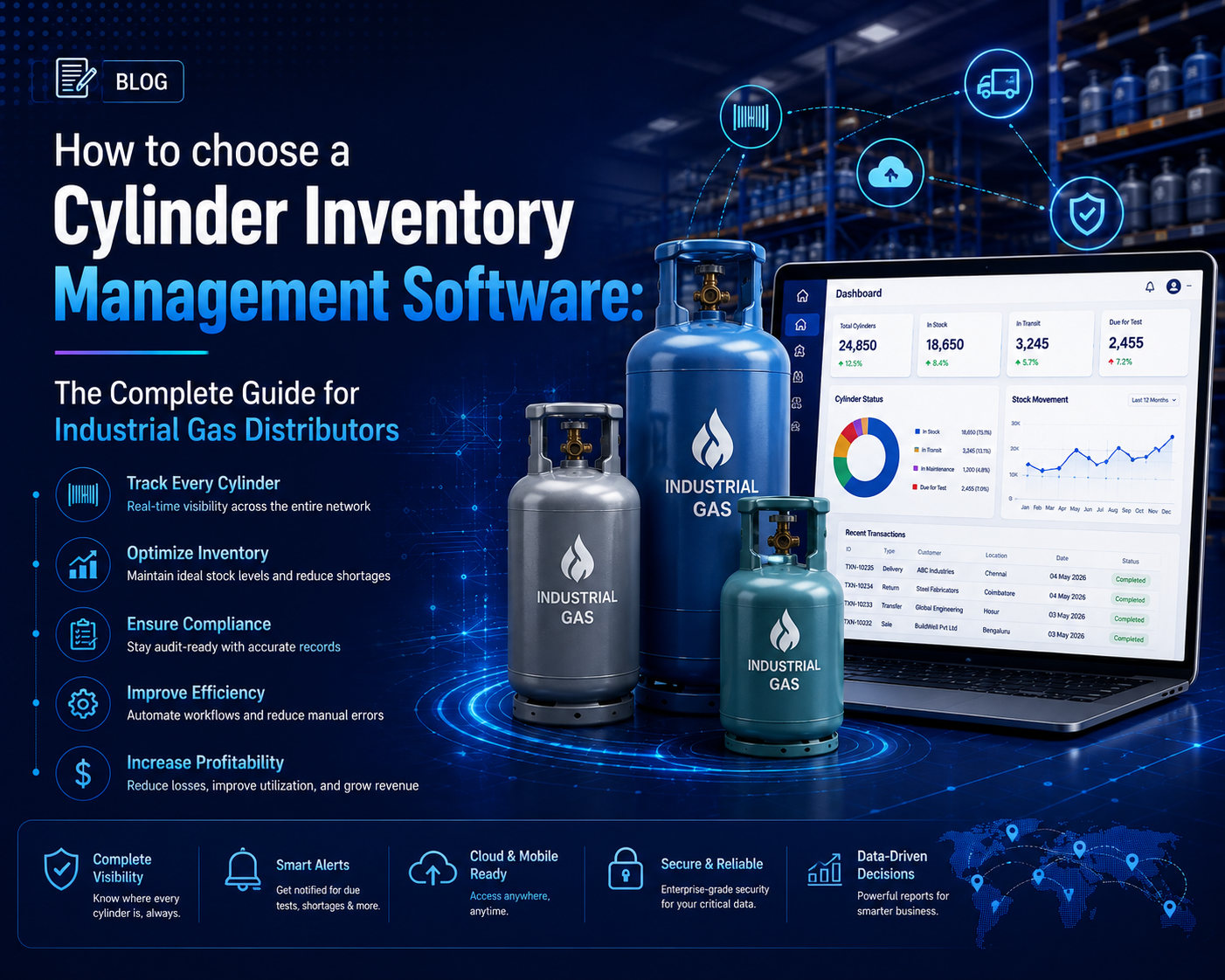
The gas industry loses 10–40% of cylinders every year, per World Liquid Gas Association figures, and most of that loss goes unmeasured. Cylinder inventory management software gives industrial gas distributors real-time visibility of every cylinder across the plant, fleet, customers, and filling station. The best platforms go beyond tracking to analytics: they measure your Cylinder Turnaround Ratio (CTR), flag the customers and routes where cylinders disappear, and turn stock data into decisions.
And because a cylinder held by a customer forces you to keep a buffer of up to seven more in circulation to maintain service, every lost cylinder quietly multiplies your capital requirement. For industrial gases, where a single oxygen, argon, or specialty gas cylinder is a far costlier asset than a domestic LPG bottle, that arithmetic bites harder.
This guide covers what cylinder inventory management software does, what features matter, how to tell a basic tracker from an analytics platform, and which products to evaluate in 2026.
What Is Cylinder Inventory Management Software?
Cylinder inventory management software records the status and movement of every cylinder in real time, across every touchpoint: the filling plant, the delivery vehicle, the customer site, and the yard. Each cylinder carries a unique ID, and every handover is logged, so you always know how many cylinders are filled, empty, in transit, or with customers, and who is accountable for each one.
It is not billing software. Billing platforms record transactions, not assets. A fabrication shop can be billed correctly and still be sitting on 40 of your cylinders for six months, and your billing system will never tell you. Cylinder tracking software tracks the cylinder itself through its full loop: filled → delivered → consumed → returned empty → refilled.
Modern platforms do this without exotic hardware. A durable tag on the cylinder, a barcode or QR code, and a mobile scan at each handover is enough. Some vendors push RFID, but for most distributors a scan-based system covers the requirement at a fraction of the cost, using the vehicles and staff you already have.
Cylinder Tracking vs Cylinder Analytics: What's the Difference?
Here is the distinction almost every vendor and article skips.
Tracking tells you where your cylinders are. Analytics tells you why you keep losing them.
Tracking is the foundation: cylinder #4271 is at customer X, scanned in on 14 July. Necessary, but static. Analytics looks at the same data over time and answers the questions that protect your margin:
| Cylinder Tracking | Cylinder Analytics |
| Where is each cylinder right now? | Which customers hold cylinders the longest? |
| How many are filled, empty, in transit? | Which routes and delivery staff account for the most loss? |
| Who received this delivery? | What is my Cylinder Turnaround Ratio, and is it improving? |
| Which cylinders are overdue for return? | Should I charge demurrage, and to whom? |
| Is the count right today? | How many cylinders do I actually need to buy next quarter? |
One metric deserves to be your anchor. Cylinder Turnaround Ratio (CTR) measures how many revenue cycles each cylinder completes in a period: out filled, back empty, out again. A healthy CTR means your capital is working. A falling CTR means cylinders are sitting idle, and you are compensating by buying more, which is exactly the 7x buffer trap. Most distributors have never seen their CTR because their systems cannot compute it. Once you can, purchasing, deposit policies, and demurrage billing stop being guesswork.
How Do Gas Distributors Manage Cylinder Stock Today?
For most mid-size distributors with 500 to 5,000+ cylinders in circulation across oxygen, nitrogen, argon, CO2, acetylene, and specialty gases, the honest answer is some combination of:
- A paper register or Excel sheet at the yard, updated when someone remembers
- Physical stock counts once or twice a week, two to four hours each time
- Informal follow-ups with drivers and customers about unreturned cylinders
- A billing system that tracks invoices, not assets
This works right up until it doesn't. The usual trigger is an audit that exposes thin documentation, a loss spike that finally gets tallied, or a principal or major account asking for cylinder balances that nobody can answer with confidence.
The underlying issue: manual systems record transactions, not accountability. When a count comes up short, there is no trail showing which route, customer, or handover the cylinders vanished from. So the loss gets written off, the register gets adjusted, and the same thing happens next quarter.
Key Features to Look for in Cylinder Inventory Management Software
Use this as your evaluation checklist. Any serious platform should cover the first six. The last three separate an analytics platform from a basic tracker.
| Feature | Why It Matters |
| Cylinder-wise tracking (serial/QR) | Every cylinder gets a unique, durable ID. Without asset-level identity, you are tracking totals, not cylinders. |
| Real-time stock dashboard | Filled, empty, in-transit, and at-customer counts by gas type, visible at any moment, without a physical count. |
| Customer-wise allocation and deposit tracking | Know exactly how many cylinders each customer holds, for how long, and against what deposit. |
| Delivery staff accountability | Every handover is scanned and attributed. Loss stops being anonymous. |
| Refill cycle visibility | See each cylinder's full loop and spot cylinders stuck at any stage. |
| Compliance and audit reports | Statutory test-date tracking (e.g., PESO hydrostatic test due dates) and clean records ready for inspection. |
| Multi-plant / multi-depot support | Larger distributors need consolidated visibility across locations, with transfers tracked between them. |
| Billing integration | The system should connect to your existing billing workflow (e.g., Tally), not replace it. |
| Analytics module (CTR, loss patterns, forecasting) | Turnaround ratios, customer and route loss analysis, demand forecasting, demurrage computation. This is where tracking becomes profit protection. |
One practical note: you are an operations buyer, not an IT buyer, so ask every vendor two questions. How do cylinders get onboarded (tagging method, durability, cost per cylinder)? And how long until my team runs it without hand-holding? A good platform trains a yard team in days and does not require an IT department.
See how CATalytics handles every item on this checklist, including the analytics layer most tools skip. Book a 20-minute demo.
Real-World Proof: What Cylinder Analytics Looks Like in Practice
Theory is easy. Here is what the analytics layer looks like when it is running.
CATalytics, the cylinder asset tracking and analytics platform from LIFO Technologies, is deployed with industrial gas operators including Yateem Oxygen Co. in Bahrain, Praxair, and AIRTEC, across the Middle East and India. Each cylinder is fitted with a stainless steel ring carrying a scannable code, built to survive the handling, heat, and repainting that kills paper labels. Every movement is then logged against the owner, customer, filling station, and location.
What changes for the operator:
- Filling station efficiency becomes visible. Throughput per plant, idle stock, and bottlenecks show up on a dashboard instead of in arguments.
- Customer holding patterns surface. The system shows who sits on cylinders beyond agreed terms, making demurrage billing automatic and defensible.
- CTR becomes a managed number. Turnaround is reported month over month, so a slipping ratio triggers action before it triggers a purchase order.
- Compliance stops being a scramble. Hydrostatic test due dates are tracked per cylinder, so PESO inspection readiness is a report, not a project.
- Sales and rental reports come from one source of truth. Asset data and commercial data are linked, so the yard register and the billing system finally agree.
That is the difference in practice. A tracking tool would have told these operators where their cylinders were. The analytics layer tells them which parts of the operation are leaking money, and by how much.
Curious what CTR dashboards would show for your operation? Request a personalised walkthrough.
Frequently Asked Questions
What is cylinder inventory management software? A digital system that tracks every cylinder's status and movement in real time across the plant, fleet, customers, and yard, using a unique ID per cylinder. Unlike billing software, it tracks the physical asset, not just the invoice.
What is Cylinder Turnaround Ratio (CTR)? CTR measures how many complete revenue cycles (filled → delivered → returned → refilled) each cylinder makes in a period. A high CTR means your cylinder capital is working. A falling CTR means cylinders are sitting idle, forcing you to buy more than your sales volume justifies.
How does cylinder inventory software reduce theft and loss? By making every handover scanned and attributed. When each movement is logged against a driver, route, or customer, losses stop being anonymous and patterns become visible. Industry loss rates run 10–40% per year; most of that persists only because nobody can see where it happens.
Is cylinder inventory software suitable for small gas distributors? Yes. Scan-based platforms need only tagged cylinders and a mobile phone, with no RFID infrastructure or IT team. Given what an industrial gas cylinder costs, the software pays for itself in recovered cylinders alone.
How does it integrate with existing billing systems? Good platforms connect to your existing billing workflow rather than replacing it. CATalytics, for example, integrates with Tally, so asset and commercial data stay in sync without double entry.
What is the difference between cylinder tracking and cylinder analytics? Tracking answers "where is this cylinder now?" Analytics answers "why do I keep losing cylinders, which customers hold them too long, and what is my turnaround ratio?" Most products stop at tracking.
How long does implementation take? Onboarding is the main task: tagging each cylinder and registering it in the platform. A mid-size fleet can be onboarded in weeks, batch by batch, without pausing operations; yard teams learn the scanning workflow in days.
The Bottom Line
Every product in this category will tell you where your cylinders are. Very few will tell you why you keep losing them, which customers hold your working capital hostage, and whether your turnaround ratio is improving. That gap, between where and why, is where 10–40% of your fleet disappears every year.
If your registers never add up, you have been settling for tracking when the problem needs analytics.
Book a demo with CATalytics and see your cylinder data clearly, probably for the first time. Book your demo.