
As an industrial gas distributor, you’re really running two businesses at once: selling the gas and managing the cylinders that carry it. The first is straightforward. The second is where the money quietly leaks. The cylinders in your godown, the ones on your trucks, and the ones sitting at hospitals, fabrication shops and factories rarely match the figure in your register. Some have been parked at a customer for months with no rental being billed. A driver comes back with a partial load and the gap just disappears into the day's noise.
In industrial gas, that is not a small leak, because the business model runs on the cylinder itself. Most gas distributors depend on rental and demurrage income, and the cylinder is real capital, commonly worth far more than the gas it carries and considerably more again for cryogenic vessels.
There is a third cost too: under India's Gas Cylinders Rules, 2016, every cylinder must be hydrostatically tested and requalified on a fixed cycle, and a cylinder you have lost track of is a cylinder whose test date you cannot prove. When you lose track of a cylinder, you are not misplacing a container; you are eroding your capital base, giving away rental income, and carrying a compliance risk, all at once.
This guide explains how cylinder tracking actually works, not as a technology pitch but as a mechanism. We will walk you through the full lifecycle a cylinder moves through, what gets recorded at each point, what the software shows you, and what genuinely changes about the business once every cylinder is accounted for.
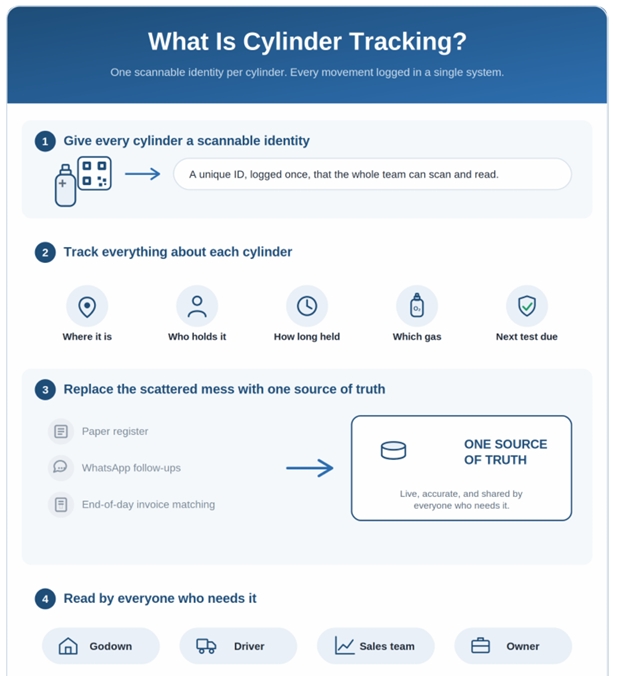
What Is Cylinder Tracking?
Why Most Distributors Lose Track: The Manual System Problem
In most manual systems, It isn’t just one component causing a big failure. It is three small ones compounding every single day.
The Register vs Reality Gap
A register records what someone remembered to write down. A physical count records what is actually there. The two drift apart constantly because a manual entry depends on a busy person logging every movement correctly, every time, by hand. A misread driver entry or an unlogged return quietly corrupts the records built on it.
What makes this so corrosive is that nobody catches the drift while it is happening. A full physical count across every gas type, every vehicle and every customer site is a days-long exercise, so most distributors run one rarely, if at all. In between, the register is treated as the truth even as it slowly diverges from reality. By the time a stock-take finally exposes the gap, the trail has gone cold: you can see that cylinders are missing, but not which deliveries, drivers or customers they left with, which makes the loss almost impossible to chase down.
Over a quarter, those small errors become a count you cannot trust, which is why so many distributors run on intuition rather than data, and end up buying new cylinders they did not actually need.
The Billing Dispute Chain
When the records are wrong, the invoices are wrong. A customer is billed for cylinders they returned, or not billed for the ones they are still holding. Each dispute costs staff time, strains the relationship, and usually ends with you writing off the difference because you cannot prove your side.
The Demurrage Leak
This is where most industrial gas distributors give away real money. A full cylinder goes out, sits at a customer's site for weeks or months past the free holding period, and no rental or demurrage is billed because nobody is tracking the holding clock.
The revenue was always there in your own asset base. Visibility is simply what makes it collectable, and over a year of deliveries, the uncollected demurrage on idle cylinders adds up to a serious number.
How Cylinder Tracking Works: Step by Step
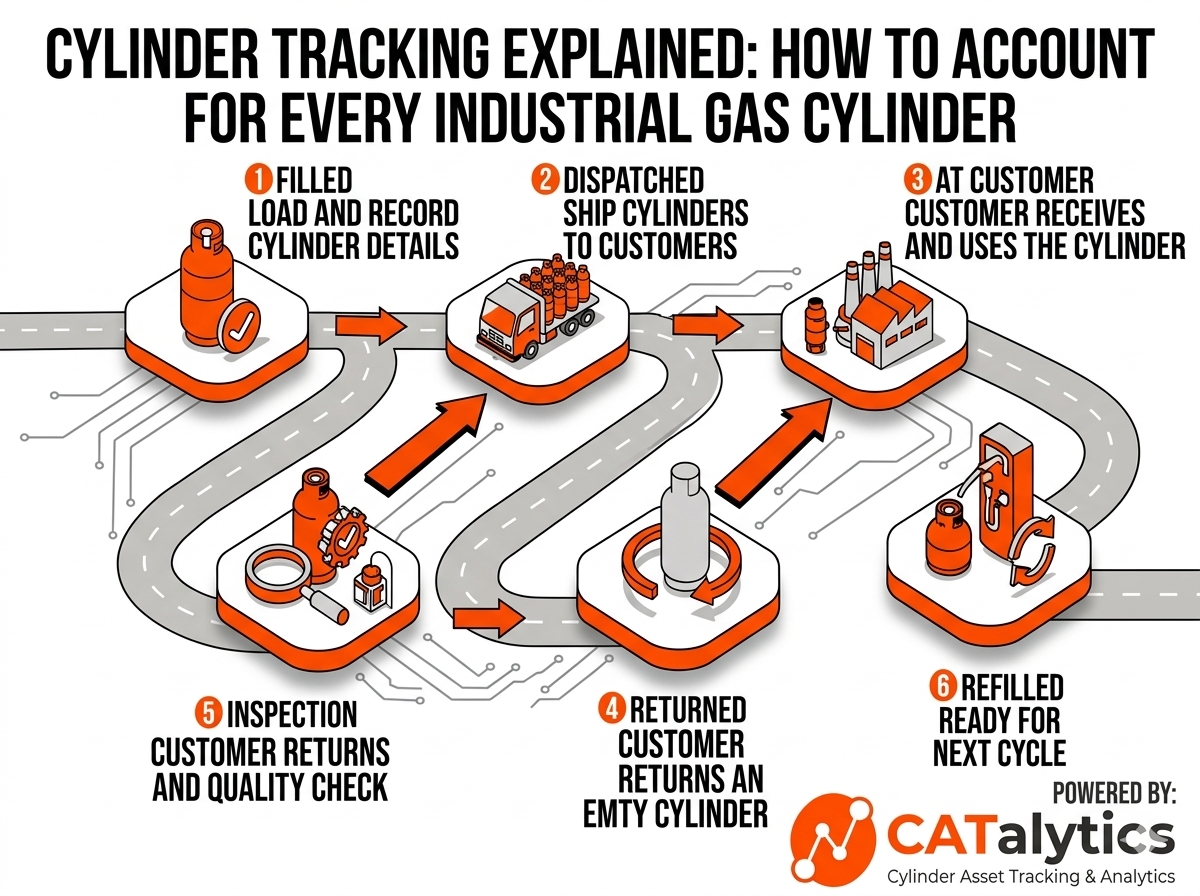
Here is the core of it. A tracked cylinder moves through six stages, and at each one, the system records a status change. The example below maps to how a platform like CATalytics by LIFO Technologies handles the flow, but the mechanics are the same across any serious cylinder tracking software.
Step 1: Cylinder Registration
Each cylinder is given a unique identity. CATalytics does this with a QR code fixed to the cylinder, either etched on a durable stainless steel (SS304) ring or as a printed sticker, whichever the client prefers, so the tag survives the rough handling, heat and weather a cylinder sees over its life. The cylinder is then registered against its owner, gas type, capacity and current test date. From this point on, every scan writes to that cylinder's history.
Step 2: Filling and Dispatch (Empty to Full to In Transit)
After filling, the cylinder sits in the godown as Full, In Stock, your genuinely deployable inventory for each gas type. When it is loaded onto a delivery vehicle, a scan moves it to In Transit. Accountability now sits with that vehicle and driver until delivery is confirmed. For the first time, "what oxygen and what argon went out on the truck this morning" is a number, not a guess.
Step 3: Delivery and DC Creation (Tally Integration)
At delivery, the cylinder is scanned to the customer and a delivery challan is generated. Good software validates the customer mapping here, so the right gas reaches the right account and a cylinder cannot be delivered against the wrong customer, and syncs the transaction to your accounts. CATalytics integrates with Tally at this point, so the DC and the billing entry are created from the same scan rather than re-keyed later, which is exactly where manual systems introduce errors.
Step 4: Customer Holding and Demurrage (At Customer)
The cylinder is now at the customer. This is the stage that decides your margins. The system tracks how long the customer has held it and runs the rental or demurrage clock automatically, so holdings past the free period are billed rather than forgotten. When a cylinder crosses an idle threshold, it is flagged for follow-up or collection. Instead of discovering idle cylinders during a year-end audit, you get a live, customer-wise list of who is sitting on your assets and what they owe you for the privilege.
Step 5: Empty Return and Collection
When the driver collects the empty, a scan returns it to your books and the plant receipt updates stock. If a return scan does not match the delivery challan, the system surfaces the discrepancy immediately rather than burying it. Partial deliveries are handled cleanly: the system records exactly what was delivered and what was returned, so the gap can never quietly vanish.
Step 6: Testing, Maintenance and Retirement (Scrap)
Industrial gas cylinders must be hydrostatically tested and requalified on a statutory cycle.
Under India's Gas Cylinders Rules, 2016, a cylinder whose periodic re-test has fallen due cannot legally be filled or transported until it has been retested at a PESO-licensed station, and the test date is stamped on the cylinder itself. An overdue cylinder is therefore both a legal exposure and a safety risk.
A cylinder pulled for testing, valve work, or painting moves to Maintenance, tracked against its test due date with overdue alerts so a requalification deadline is never missed. When a cylinder fails testing or is condemned, it is marked Scrap and formally removed from the active base, so your counts and your compliance records stay honest.
[In-article image: full cylinder lifecycle flow diagram, filling to godown to dispatch to delivery to return to testing.]
Cylinder Status Types: What Each One Means Operationally
Most articles never explain the status labels, but they are the heart of how tracking changes your decisions. Here is what each one means on the ground.
| Status | What it means | Why it matters operationally |
| In Stock (Full / Empty) | Held at your godown or plant, by gas type and fill state | Your real deployable inventory, full stock, is what you can sell today |
| In Transit | Loaded and dispatched, not yet confirmed delivered | Accountability sits with the driver and vehicle until delivery is scanned |
| At Customer | Delivered and currently held by a customer | The rental and demurrage clock is running; holding time drives billing |
| Maintenance | Pulled for hydrostatic testing, valve repair or painting | Out of circulation but tracked against statutory test dates, not lost |
| IPT (Inter-Plant Transfer) | Moving between your own plants or godowns | Still your asset, just relocating; must not be counted as a sale or a loss |
| Scrap | Failed requalification or condemned | Formally retired so active counts, valuation and compliance stay accurate |
[In-article image: CATalytics asset status dashboard showing Full / Empty / At Customer / In Transit counts.]
QR Code vs RFID: Which Should You Use for Cylinder Tracking?
It is worth understanding the two real tagging options because the choice has long-term consequences for a fleet that stays in service for decades.
QR or Item Code: Durable, Low-Cost and Phone-Scannable
A QR code or item code is scanned with an ordinary smartphone at each touchpoint, with no special reader to buy and no per-cylinder chip cost. CATalytics fixes the code to the cylinder in whichever form suits the client: etched on a durable stainless steel (SS304) ring for the harshest environments, or as a printed sticker where that is more practical and cost-effective.
In day-to-day use, the appeal is how little it demands. The same code is scanned at filling, dispatch, delivery and return, each scan taking a second on an ordinary smartphone the team already carries, so there is no specialised device to buy or maintain. Because each scan simply captures a cylinder's identity, its status and the time, a patchy network at a customer site is no obstacle: the app records the scan on the device and syncs the moment it reconnects. And if a tag is ever scratched, painted over or damaged, reissuing one costs a few rupees and a minute at the godown, which keeps even a large, ageing fleet fully tagged over time.
The appeal is how little it demands. The same code is scanned in a second at filling, dispatch, delivery and return, on a phone the team already carries, so there is no special device to buy. A weak network is no obstacle: the app stores each scan and syncs when it reconnects, and a damaged tag costs a few rupees to reissue at the godown.
India's Gas Cylinders Rules even recognise bar codes as a valid means of cylinder identification. So a scannable tag sits squarely within the compliance framework. The workflow is intuitive for drivers and godown staff, and it captures the great majority of the value for distributors and fillers managing anywhere from a few hundred to several thousand cylinders across mixed gas types.
Where RFID Falls Short on Cylinders
RFID can read tags in bulk without line of sight, which sounds ideal for a high-throughput fill plant. On cylinders, though, it carries two practical problems.
Durability: A passive RFID tag's read reliability tends to deteriorate over a cylinder's long service life as the tag takes heat, impact and weather, and a cylinder can stay in circulation for decades. A tag that reads cleanly on day one can become unreliable years later, exactly when you still need to account for the asset.
Cost and complexity: A chip on every cylinder adds a recurring per-asset cost that a printed code avoids; the fixed and handheld readers have to be bought, installed and maintained, and in hazardous filling areas, that hardware must be intrinsically safe and certified for explosive atmospheres, which pushes the price higher again. In effect, you are building and running a reader infrastructure before a single cylinder is accounted for.
This is why CATalytics is built around QR rather than RFID. A printed or etched code does not lose signal as it ages, and if a sticker ever wears, replacing it costs almost nothing. For cylinders that live for decades in rough conditions, a durable QR code gives you the same asset-level visibility, demurrage billing and test-date tracking the software provides, without the read-degradation and hardware overhead RFID brings to a cylinder fleet.
What Does Cylinder Tracking Software Actually Show You?
The tag is just the input. The value is in what the software does with every scan.
The Dashboard
A single screen shows your total assets and how they are split across statuses and gas types: how many full and empty In Stock, how many At Customer, how many In Transit, how many in Maintenance. The question that used to take a physical audit, "how many oxygen cylinders do I own and where are they," becomes a glance.
Exportable Reports
Tracking software turns history into reports you can act on: delivery and return reports, customer-wise holding and demurrage reports, test-date due reports, invoice reports, and filling-station reports. The customer-wise holding report, which lists who is sitting on how many of your cylinders and for how long, is usually the one that pays for the system several times over.
Role-Based Access
Different people see what they need. An admin sees everything, a driver sees their loads and returns on a phone, the sales team sees their customers' holdings and overdue rentals, and management sees the rollup. CATalytics by LIFO Technologies is built for exactly this use case, with QR or item-code tracking, Tally integration, partial delivery handling, the empty return flow, demurrage billing and test-date tracking designed around how Indian industrial gas distributors actually run their day.
What Changes When You Start Tracking: Before vs After
Here is the practical difference, stage by stage.
| Operation | Manual system | With cylinder tracking |
| Godown reconciliation | End-of-day count by hand, often off | Live count by status and gas type, always current |
| Driver accountability | Informal, chased on WhatsApp | Every load and return scanned to a name |
| Demurrage and rental billing | Held cylinders forgotten, revenue lost | Holding clock billed automatically per customer |
| Empty return matching | Gaps disappear into the day | Mismatches surfaced against the DC instantly |
| Test-date compliance | Tracked on a wall chart, easily missed | Overdue alerts before a requalification lapses |
| Tally and billing entry | Re-keyed later, error-prone | Generated from the delivery scan |
| Audit time | Days of physical counting | A report you export in minutes |
The change is not subtle. Once every cylinder is scanned at each stage, the godown count stops drifting, idle cylinders surface while they can still be recovered, demurrage that was quietly leaking gets billed, and your test-date records become audit-ready instead of a scramble before an inspection. If your operation looks like the left column above, a platform like CATalytics can move you to the right in a matter of weeks, not years.
How can Catalytics help?
The honest framing up front: cylinder tracking is not a software upgrade; it is accountability infrastructure. Every untracked cylinder is a financial liability and, when its test date lapses, a safety and compliance one too.
The gap between your current reconciliation headache and a fully tracked operation is almost always smaller than it feels, and the cost of staying manual is paid quietly every month in lost cylinders and unbilled demurrage.
If you are managing more than a few hundred industrial gas cylinders and still reconciling by hand, speak to a CATalytics expert to see how the system maps to your current operation.
FAQ
How does cylinder tracking work without RFID?
QR or item-code tracking works without any RFID hardware. Each cylinder carries a scannable QR code on a stainless steel ring or a sticker, and staff scan it with a normal smartphone at filling, dispatch, delivery and return. The software records the status change against that cylinder each time. Besides being far cheaper, a printed code does not suffer the read-reliability loss that RFID tags can develop as they age on a cylinder, which is why QR is the practical default for industrial gas distributors.
Can cylinder tracking software bill demurrage automatically?
Yes. This is one of the biggest reasons industrial gas distributors adopt tracking. Because the system records exactly when each cylinder reached a customer, it runs the rental or demurrage clock automatically and flags holdings past the free period, so the revenue is billed instead of quietly lost. Software like CATalytics generates these charges and the customer-wise holding report directly from scan history.
How do you track gas cylinder test and requalification dates?
Each cylinder's test or hydrostatic requalification date is stored at registration and tracked over its life. Under India's Gas Cylinders Rules, 2016, a cylinder that is overdue for its periodic re-test cannot be filled or transported, so the software raises overdue alerts before a deadline lapses and holds the cylinder in a Maintenance status until it is requalified at a licensed station. That keeps your fleet compliant and your records audit-ready.
What is the difference between cylinder tracking and inventory management?
Inventory management tells you how many cylinders you have. Cylinder tracking tells you where each cylinder is, who holds it, how long they have held it, which gas it carries and when it is due for testing. Tracking is asset-level and movement-aware, which is what makes demurrage billing, loss reduction and test-date compliance possible.
How many cylinders do you need before tracking software makes sense?
There is no hard threshold, but distributors usually reach a breaking point with manual methods somewhere in the hundreds of cylinders, once reconciliation and demurrage stop being something one person can hold in their head. If you are managing several hundred or more across multiple godowns, vehicles and customers, tracking generally pays for itself quickly through recovered assets and recovered rental revenue.
Does cylinder tracking software work on mobile?
Yes. QR-based tracking is designed around mobile scanning, so drivers and godown staff use a phone in the field while managers view dashboards, demurrage reports and test-date alerts from anywhere. Mobile access is what makes the system practical for day-to-day distribution rather than a back-office tool.
Sources
- India's Gas Cylinders Rules, 2016 (under the Explosives Act, 1884; administered by PESO): mandatory periodic hydrostatic testing, the test date stamped on the cylinder, and a prohibition on filling or transporting a cylinder that is overdue for re-test. https://indiankanoon.org/doc/195739662/
- Gas Cylinders Rules, 2016 overview: periodic testing per BIS IS:15975, with composite cylinders requalified every three years under ISO 11623 / ISO 19078. https://sjexim.services/2026/01/03/gas-cylinders-rules-2016-comprehensive-overview-and-key-amendments-explained/
- Gas Industries Association (India), on periodic inspection and requalification of high-pressure cylinders as a statutory safety requirement. https://gasassociation.in/gia-docs/en_GIA__002_19.FInal.pdf